Ep 139: Evolution across scales (with Mike Lynch)
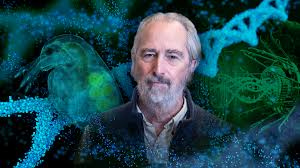
How do non-adaptive processes shape biological diversity and complexity? What is effective population size and what important role does it play in evolution?
On this episode of Big Biology, we talk with Dr Mike Lynch, Regents Professor and the Director of the Biodesign Center for Mechanisms of Evolution at Arizona State University. We talk with Mike about his research understanding the diverse genetic forces affecting evolution including genetic drift, mutation, and recombination that shape biological diversity. Mike is also the author of four books, and we explore some ideas from his most recent book Evolutionary Cell Biology: The Origins of Cellular Architecture.
Cover art by Brianna Longo
-
Cameron Ghalambor 0:04
Hey, Marty, are you familiar with the story about Charles Darwin, the star orchid, and the Madagascar hawk moth?
Marty Martin 0:12
I think so. Is that the one where Darwin saw the orchid with the super long nectar tube and predicted that there had to be a moth somewhere on the island with an equally long proboscis to pollinate it?
Cameron Ghalambor 0:23
That's the one. And years later, naturalists found that hawk moth. Apparently, when Darwin saw this 30 centimeter long nectar tube, he exclaimed: "Good heavens. What insect can suck it?" And he speculated it had to be a moth with an equally long tongue. And actually, a few years later, Alfred Russel Wallace saw the same orchid, and he wrote: "That such a moth exists in Madagascar may be safely predicted, and naturalists who visit the island should search for it with as much confidence as astronomers searched for the planet Neptune, and they will be equally successful."
Marty Martin 0:23
Yeah, I like Darwin's take a lot better. It's much more to the point about seven words and it captures the same sentiment.
Cameron Ghalambor 0:23
I'm not surprised at all you say that you with your sort of predilection for brevity. Anyways, stories like this provide textbook examples of how natural selection can drive the co-evolution of plants and their pollinators.
Marty Martin 0:23
Right, because it's really hard to explain how the orchid and the moth pollinator would evolve these exaggerated traits by any other evolutionary process.
Cameron Ghalambor 0:29
True, the chances that the moth and orchid evolve these traits totally by luck or mutation is essentially impossible. But at the same time, we have to be careful not to view all variation that we see as adaptive.
Marty Martin 1:43
So true, Dr Pangloss. There is certainly a long history of biologists telling "Just So" stories, without a lot of support that natural selection played any role, or at least the one that seems obvious.
Cameron Ghalambor 1:55
Exactly. Population genetics tells us that all sorts of other processes, such as mutation, genetic drift, gene flow and recombination influence evolutionary outcomes. Ah, but biologists often gravitate towards adaptive explanations.
Marty Martin 2:10
Our guest today is Mike Lynch, a professor in the School of Life Sciences and director of the Biodesign Center for Mechanisms of Evolution at Arizona State University.
Cameron Ghalambor 2:18
Mike is also a member of the US National Academy of Sciences, and a fellow of the American Academy of Arts and Sciences. He has served as president of the Genetic Society of America, the Society for Molecular Biology and Evolution, the Society for the Study of Evolution and the American Genetic Association.
Marty Martin 2:36
Many of our listeners may be familiar with Mike's work because he has worked in so many biological subdisciplines, from population and quantitative genetics to the evolution of genomes and more recently, the field of evolutionary cell biology.
Cameron Ghalambor 2:50
Throughout his career, Mike has been a strong advocate for considering other evolutionary processes besides natural selection and evolution, particularly the importance of effective population size and genetic drift.
Marty Martin 3:03
Cam and I recently attended Mike's plenary talk at the European Society for Evolutionary Biology meeting, where Mike showed a slide of variation in the structure of snowflakes.
Cameron Ghalambor 3:13
Mike argued that if these snowflakes were phenotypes, many evolutionary biologists would be tempted to invoke natural selection as the cause of variation in and among them.
Marty Martin 3:23
But the problem? There is no reason to expect snowflake structure to be adaptive at all. Snowflakes get their complex hexagonal shape simply because of how water molecules freeze.
Cameron Ghalambor 3:35
The complex and intricate branching of each snowflake is determined by the constantly changing temperature and humidity conditions the crystals encounter as they fall through the atmosphere, not because some snowflakes are fitter than others.
Marty Martin 3:49
Mike's relatively unique take on evolutionary theory has helped us to appreciate much better the importance of non-selective forces such as mutation, drift and recombination in evolution.
Cameron Ghalambor 3:59
Mike's interest in the evolution of biological variation across scales has enabled him to become a leader in Integrative Biology. He has made major theoretical contributions and also works empirically across several systems, from the micro-crustacean daphnia to the ciliate paramecium, as well as numerous microbial species.
Marty Martin 4:18
We talk with Mike about his career trajectory and how he has moved so effectively across different fields.
Cameron Ghalambor 4:24
We also discuss with him his research on the importance of population size and genetic drift in evolution,
Marty Martin 4:30
And we wrap by talking about the challenges of integration in biology, despite how important we all agree integration to be.
Cameron Ghalambor 4:36
And two last things before we start the show, first, we want to encourage you to check out "Nice genes!", a podcast from GenomeBC.
Marty Martin 4:44
If you're like me and you love unraveling the weird, wonderful ways that our genes shape everything from our health to how we understand the world around us, this is the podcast for you.
Cameron Ghalambor 4:53
Season Five of nice genes is out now, and every episode dives into a different genomic. History, like why elite athletes suddenly collapse, or how your gut bugs mess with your mood, or how medical dramas warp our view of science.
Marty Martin 5:10
I've been listening, and what I really like is how the show takes these complex scientific topics, but turns them into stories, personal stories, without dumbing down the science. It's a smart show, surprising and genuinely fun to listen to.
Cameron Ghalambor 5:23
So if you're looking for a new show, check out "Nice genes!". Season Five is streaming now. Just search "Nice genes!" wherever you get your podcasts.
Marty Martin 5:32
And the last thing before we start the show, remember, we are in fundraising mode.
Cameron Ghalambor 5:37
Our goal is 500 paid Substack subscribers. And since our last episode dropped, you all have done a fantastic job of supporting our cause. Thank you. Please keep it up.
Marty Martin 5:48
And if you haven't become a subscriber yet, go to bigbiology dot substack dot com and sign up.
Cameron Ghalambor 5:53
Remember, for every 20 new paid subscribers, we're going to randomly select someone to receive a big biology t-shirt or a poster with cover art from one of our episodes.
Marty Martin 6:03
And when we get to 500 subscribers, that lucky person will get a big biology sweatshirt and a large art print.
Cameron Ghalambor 6:11
And of course, those prizes are in addition to the benefits that paid subscribers already get, such as access to whole episodes, episode debriefs and extra audio from our guests about their lives and hobbies.
Marty Martin 6:23
So again, please go to bigbiology do substack dot com and sign up today.
Cameron Ghalambor 6:27
I'm Cameron Ghalambor.
Marty Martin 6:28
And I'm Marty Martin.
Cameron Ghalambor 6:29
And you're listening to Big Biology.
Cameron Ghalambor 6:42
Mike, Lynch, thanks so much for joining us today on Big Biology.
Mike Lynch 6:46
You're welcome.
Cameron Ghalambor 6:47
So to get things started, I think, you know, I'm just personally very interested in your career progression. I'm old enough that I started reading your papers on daphnia when I was a graduate student, you know, they were on daphnia population dynamics and community structure and predation and very ecological, very, I would even say, like limnological, in their in sort of their approach. And then, you know, at some point I saw this transition where, you know, you moved into quantitative genetics, and you were doing, you know, genetic covariances of life history traits in daphnia and there was this real shift towards, you know, much more traditional evolutionary biology. And I was curious, like, what was going on during, like, maybe the mid-80s that, you know, inspired you to make this kind of shift in research. Was it like, Marty and I were talking about, you know, the Chicago school during that time when, you know, all these prominent evolutionary biologists were kind of dominating the way we think about evolution at that time. Did that have an influence on you?
Mike Lynch 8:03
Well, I'm glad you recognized that it was me who worked at daphnia. There's an amusing story here. In Barcelona, a postdoc walked up to me and said he enjoyed my talk. And did he know there was somebody else named Mike Lynch who had done a lot of work on daphnia? I assured him I am one in the same person.
Mike Lynch 8:25
Yeah, I have wandered quite a bit in my career. I started out in the field of limnology, the study of lakes. I was really attracted to it, you know, part of it is I grew up on a lake, I guess, simple as that. And Minnesota had 10,000 of them. So I sort of gravitated to Minnesota, but I really like the breadth. I mean limnology really covers all the sciences, physics, chemistry, geology and biology. So I was attracted to that, and I was fortunate to be in a lab. It was a tough lab to be in, but my advisor pretty much gave me free reign to a grant. We were interested in figuring out how to control the consequences of phosphorus going into lakes by not controlling sewage treatment plants, because the inputs were from agriculture, so there's no point source, and we were trying to control it by manipulating community structure. So okay, we could get the daphnia to graze more on the algae and keep things the water transparent despite high phosphorus concentrations. And how do we do that? Well, we eliminate the fish that eat the daphnia. And how do we do to that? Well, we put top level carnivores in there to eliminate the smaller fish. And so we did some of the first, maybe the first whole lake manipulations and so on, and divided ponds in half and changed predator concentrations and so on. And it was great. I was modeling community structure and so on for zooplankton and phytoplankton. And I really enjoyed that as my first introduction to math, and I learned that you could use math and biology.
Mike Lynch 10:03
But I started worrying about whether the results I was developing were generalizable to other kinds of ecosystems and communities. I didn't have any background, really, in evolution at the time, and my first job was at University of Illinois. I was hired as an aquatic ecologist, where I taught limnology for seven years, but it was also, it turns out, a really great place for evolutionary biology at the time. This is where Carl Woese was, discovering the third form of life, just a floor down. And I started learning about what population genetics was in my last year of grad school. I sat in on a class by Mike Simmons, who taught PopGen. It was all just theory, "P and Q genetics", we called it at the time because there were no data in population genetics yet, but I learned how beautifully quantitative it was and elegant and generalizable. And so I started thinking about that in my first couple of years at University of Illinois. And I was a fortunate victim of benign neglect by my department head, which enabled me to wander into a whole other area that nowadays most department heads would not allow you to do, right?
Cameron Ghalambor 11:21
Didn't we hire this guy as a limnologist?
Mike Lynch 11:24
Yeah, that's basically it. But it was the best things that ever happened to me. And then this was in the early allozyme days. Most people no longer know what allozyme electrophoresis is, but I started playing around with it with our daphnia, which can be raised colonially in the lab, and we were grinding up individual to daphnia and cooking up our own electro starch and dividing gels with a guitar string. That's how things were back in those days. And it all worked immediately. I did this with a Drosophila friend named Bill Steiner, and that just got me going. It was rather an easy way in experimentally. So that was the connection with daphnia, essentially. And that's how I got into PopGen. And then I slowly started developing theory, as I learned a lot of PopGen there. University of Illinois at the time, had one of the best groups in quantitative genetics. They were all in animal breeding at the time. They knew very little about the evolutionary things that we worked on. But this was a great time for me. Really excellent people down there on the faculty, and we sat around and read all the classics all the way back to 1918 Fisher's paper, and did everything from first principles. So hugely valuable time for me.
Marty Martin 12:45
Yeah, so Mike, you alluded twice, or maybe three times, to generality. Is that what sort of drawn you? I mean, and you know, the other things we're about to talk about suggest that you're really seeking generality. In my experience, you know, that's not something that a lot of biologists go for, but it seems to be a passion that you have.
Mike Lynch 13:05
Yeah. I mean, a big segment of my lab is still the daphnia work, which is rather specific, focused on one metazoan. We are doing a lot of things with it, all the way from quantitative genetics to population genomics to now single-cell biology, but I'm really quite interested in the broader picture of evolution now, across the entire tree of life, ranging from archaea and bacteria to us, who now seem to be a derivative of archaea, and we're working on viruses as well now. And I've gotten a bit interested in the origin of life, which maybe is just something that happens to you when you get old and haven't got anything better to do, I guess. But I'm really trying to think of general principles in evolutionary biology, both from an observational point of view, and trying to develop a theory to explain these patterns for first principles, in other words, not just identifying scaling patterns, but trying to figure out what, what's really driving these.
Cameron Ghalambor 14:08
Well, you've done quite an amazing job, you know, making this transition. Not only did you like move into this field, but you know, with Bruce Walsh, you wrote the massive treatise on quantitative genetics. You've also moved into doing like, you know, publishing books on evolution of genome architecture, on, most recently, evolutionary cell biology. And Marty and I talk a lot about like moving between disciplines within biology and sort of the challenges of integrating and just like becoming familiar with the vast amount of literature associated with these sub-fields. And I'm just curious like, you know, this is not, this is not just a trivial thing that anybody does, like, how? How have you managed to make these transitions over your career?
Mike Lynch 15:10
Yeah, I guess that's not normal behavior for a scientist. And you may have seen it, there's a paper in Nature a few months ago, some guys from information science or something, the title of the paper was: "The Pivot Penalty", and they did make the point that the farther one shifts one's original area of research, the less influence one has. So this has got me a bit nervous. It hasn't been easy, but, and I'm pretty well-known, probably, for being critical for people coming into evolution, from different areas, and claiming to have identified new principles that we've missed for the last century and so on. And these people have generally not done their homework. They generally know nothing about the field. So my general feeling is, if you want to go in and move into a new field, it's going to take some effort, and you're not there until you really have a deep enough understanding that you know what you don't know.
Mike Lynch 16:13
And so when I switched into genomics, of course, that was just happening, when I was making the switch, but I even when I switched into evolution, I felt pretentious for a good decade before I would call myself an evolutionary biologist. Probably other people were calling me an evolutionary biologist, but I didn't feel like I knew the field well enough. Same thing in genomics that took about 10 years, and the same thing happened with cell biology that took another good 10 years. Now, fortunately, I've been around for a while, but these are pretty vast areas, and you need to understand what is known from an evolutionary perspective. You need to know what we care about, and we don't care about where every single electron is, but you need to know where to draw the line. There's a huge number of cell biologists out there and genomicists and lot happening. In some sense, it's a real privilege because, you know, I'm just parasitizing on the knowledge base that these guys have been setting up for years and years and years. So in that sense, it's been a really good time to make these transitions.
Marty Martin 17:20
Yeah, so that's a it's an interesting take. And I mean, you know, it's impossible to argue that more knowledge is going to help for the rigor of the science. We've had at least two different people on the show before that have argued, and I've heard other people make this argument in other podcasts and other contexts, that sometimes naivety is powerful because it begets creativity. So what do you think about that? I mean, you know what? You were just saying that leveraging all of the cell biology that's around. I mean, you walking into this rich field that you're bringing your own experiences so right out of the gate. I mean, it seems to me that there would be some novelty before you really even learn. You take what's there, and you apply a mindset that maybe a lot of people haven't before, is there? Is there value in that? And, I mean, do you know of personal experiences? Can you think of personal experiences where that kind of thing has happened?
Mike Lynch 18:11
Oh, I don't disagree with that point of view at all. I totally agree with it. But you still need to do your homework, because naivety can just put you in fringe lunatic territory,
Marty Martin 18:22
That's true
Mike Lynch 18:23
So you need to be careful. But when I moved into genomics, for example, and evolution of genome architecture, I profited enormously from having a background in population ecology. So, as an example, for evolution of duplicate genes. I realized. "Oh, we can use the same mathematical framework we used for looking at survivorship curves of individuals and populations. You could use that same theory for thinking about the survivorship of duplicate genes in genomes." So that worked out really well. We were able to use basically pre-existing machinery, tweak it a little bit and figure out the birth and death rates of duplicate genes.
Cameron Ghalambor 19:10
Well, okay, so there's a lot we could talk about, but let's, let's switch to, I think, a common theme that has run through your research in evolutionary biology, which is sort of the pushback against viewing everything as an outcome of natural selection. And you've always been very strong in terms of advocating for a more balanced view of, in particular, embracing the importance of drift, mutation, you know, to some degree, I guess, recombination as well, and how these different evolutionary forces shape biological diversity at sort of all levels of organization. Is that a fair assessment of kind of, what you see yourself doing?
Mike Lynch 20:00
Yeah, that's how I gravitated over the past few decades. I mean, I first got very interested from a quantitative genetics perspective, just trying to set up a null model, really, for how quantitative traits might evolve. It was really, primarily, for statistical reasons to you know, if we're going to invoke selection, we ought to be able to reject the null model. But then, as I got more and more into molecular evolution, I mean, I'm not the only one, people were starting to think that there's a lot going on at the DNA level that can't be explained by natural selection. I took that to a higher level when I got into genomics with things like gene duplication and intron expansion and so on. But then I've continued to move into this, and when I got into cell biology, and I really didn't think that a lot of these ideas would translate to cell biology, because you would think, if you're going to a higher and higher level of organization, that there'd be less and less of a chance for evolution to be neutral. But it turns out, there are many things in cell biology I think that are quite compatible with neutral sort of forms of evolution, and that might be simply due to there's more degrees of freedom at the cell level for things to move around and sort of neutral pathways. For example, rewiring a network seems to be a common thing. Suddenly, you've got two organisms, they have basically the same network structure, and they're using different molecules on the pathways. There's a lot of stuff going on, like that, evolution of complexes like the ribosome, which is a quite a mess. People talk about the onion skin model for the evolution of the ribosome. And as we got into eukaryotes and then into multi-cellular species, we just kept adding more and more layers onto the ribosome. And there's sort of neutral ways that can happen. There's no evidence that our ribosomes are better because we've got all these adventitious proteins glued to the outside. So there's a lot of cellular sort of complexity that seems to evolve for reasons that can't easily be explained by selection.
Marty Martin 22:09
One of the themes that maybe we should, I guess, another idea to bring up here that I found, you know, really exciting, and especially the first chapter of the of your new book is effective population size, because, you know, sort of there are two things that that were thematic in the in the readings I was doing to prepare is that, you know, sizes of species are strongly going to affect the relative roles of selection and these other mechanisms. Maybe, before I go on, do you want to talk a little bit about how that comes into play? You pose this really cool question later about where selection sort of takes over as a, maybe the dominant force, but we could come to that one, come to that one later. What's effective population size and how does it play in here?
Mike Lynch 22:53
Well, it's a pretty complicated technical topic.
Marty Martin 22:57
Yes it is
Mike Lynch 22:57
To put it mildly. And to make matters worse, there's one more than one kind of effective population size.
Marty Martin 23:04
Great
Mike Lynch 23:04
But from our standpoint, the most important thing, the way to think about it is, if you have some number you call the effective population size the inverse of that is related to the noise in the evolutionary process. It's like flipping a coin, the more times you flip the coin, the closer you're going to get to a 50/50 prediction, assuming an unbiased coin, that's essentially what's going on. But there's a lot more going on in population size and genetics than numbers of individuals. So it's sort of a composite way of putting everything together that influences the noise in the evolutionary process. One of the biggest sources of noise is not numbers. It is, probably, in vertebrates, but not in unicellular things. The biggest source of noise is the fact that our genes are glued together on chromosomes, which means that mutations that arise at one point are not independent of the ones that are linked to them, and that causes all kinds of selective interference. Beneficial mutations are not as beneficial as you'd expect because they're linked to a deleterious mutation, or maybe they're linked to another beneficial mutation, and that's what causes the noise in the evolutionary process. And the fundamental question is, is the level of noise greater than the strength of selection operating in a nucleotide? So you can think of strength of selection as deterministically moving, you know, an allele, a mutant allele, forward. But if you've got a lot of noise going on, if those fluctuations are big and larger than the deterministic change per generation, then the noise wins. It'd be like driving down a highway in a fog. You've still got the, you know, the pedal to the metal, but you end up in New Mexico instead of Utah or something. So, I mean, that's more or less what's going on, that's the verbal description. There's a lot of math.
Marty Martin 25:02
Yeah, well, that, I mean, that was brilliant, Mike, I'm really impressed at how well you, I'm sure you've had the opportunity many times to lay out that complicated idea quickly. But, you know, to put it back to the ribosome example, you're giving these embellishments that we sort of, you know, often lots of people would look at diversity within a particular species that could have a particular population size, and this sort of shifts your mindset to thinking that that's some kind of, you know, diversification in response to selection, whereas maybe it's just this driving in the fog kind of thing.
Mike Lynch 25:35
Yeah, that's, that's the basic idea. I mean, intron evolution, our genes are packed with introns. And they are useful in multi-cellular species for alternative splicing of genes and tissue-specific alternative splicing, but introns didn't arise in a multi cellular species. They rose in a single celled ancestor of eukaryotes. So their original purpose could not have been tissue-specific alternative slicing, but they're basically a consequence of parasitism by mobile elements from bacteria, originally.
Cameron Ghalambor 26:08
Yeah. So, I mean, this kind of touches on your drift-barrier hypothesis, which, you know, basically is arguing, yeah, you're, you're driving in the fog, the effectiveness of selection to improve any trait is going to hit some limit, and that limit is going to be determined largely by the population size and the power of random drift to sort of prevent selection from fixing beneficial mutations in populations. And I guess, you know, I've thought about this in the systems that I work on, and I work on vertebrates, well now maybe more with some with invertebrates, but I, you know, I've worked a lot on things that have very small population sizes, very small effective population sizes, guppies in Trinidad, and I work on a species that is confined to a single island, it's North America's only island endemic bird species. And what amazes me is that, in both of these cases, these populations exhibit, you know, local adaptation, and seemingly have persisted in these environments for a very long time, and I've, I've always tried to reconcile how they do this with such small populations. And I'm just curious, am I thinking about this wrong? How do populations escape the drift-barrier, because it seems like, you know, based on theory, a lot of these populations should have gone extinct long time ago?
Mike Lynch 27:48
Yeah, I don't think they're entirely inconsistent. I mean, most of what I've been talking about is really big-picture, long time-scale, you know, hundreds of millions of years to billions of years. And another thing that one needs to keep in mind is there's drift around the drift-barrier. I mean, this is a process of noise in the evolutionary process, so it's not deterministic. And, in fact, most of the patterns that I have been pointing out over the years, it's across the whole tree of life. So we have, you know, scaling properties over 20 orders of magnitude of different organism sizes. But if you look at any one point, there could be up to an order of magnitude variation around the overall pattern. So there's a very clear, strong pattern, but there's noise in any one particular position. And that could cause things to go, you just pick through species and okay, there's noise in this range here, but you know, okay, maybe one's over here and one's over here, it's going in exactly the wrong direction when the general pattern. So you have to be careful about individual species. But for the kind of things you're talking about, probably a lot of the traits are quantitative traits that are being under selection. There's a good number of degrees of freedom to modify those traits, and these are short-term, small populations, right? So if we extended these out a few orders of magnitude, it seems unlikely, although it'd be very interesting, that they'd still be surviving, and that there wouldn't be some deep changes at the genomic level.
Cameron Ghalambor 29:20
Yeah. Well, because you said degrees of freedom, I have to tell you about this result that we have in in sort of revision right now, which is like with this bird population on the island, they showed over very small scale geographic variation in their bill length that seems to be locally adapted to feeding on pine trees and pine cones, and even when we're talking about just like a few kilometers away when we when we scan the genome and look for outlier loci and try to identify the the genes under selection. If you just look at SNPs, there's zero overlap between like sub-populations on the same island. But then if you look at the actual genes that are in linkage with those SNPs, then you start to see more overlap. And then if you go, if you then map those genes onto the pathways that we know affect bill length, then we see even more overlap. And so it does seem that like there is a lot of flexibility and a lot of degrees of freedom, but then they kind of funnel and become less options are available once you start to get to those pathway levels. Is that sort of along the lines of what you were describing?
Mike Lynch 30:37
Well, I think it relates to the point I was making before about molecular genome evolution, lots of neutrality, and then moving on to the cell level, and anticipating maybe there wouldn't be so much. But turns out, there is quite a bit, because of this degrees of freedom issue, maybe, and that now if we go to higher levels of organization, ie multicellular organisms, you know, maybe these kinds of patterns won't hold up quite as strongly, but you can also imagine, for a vertebrate or an animal with behavior that there are extra degrees of freedom. So you can, you know, if you're behaviorally sophisticated, you can, you know, make the best of a bad phenotype by shifting behaviorally into the right environment. And now we go back and look and wow, the fits really good, but that was because behavior allowed you to make that fit, and not always, necessarily, because you endogenously evolved the new phenotype. So I know people have talked about this a bit. Alan Wilson, decades ago, talked about what he called behavioral drive, for example. I mean, he was thinking about an organism moving into a new environment that didn't fit so well, so that that would drive behavior, or behavior would drive you to fit well. I know that we don't need to do further work to follow that up. But there is this connection, at least in animals, I think that's worth thinking about, you know, once we have nerve systems so on.
Marty Martin 32:09
Huh. Do you think that that could apply physiologically, too? I mean, if we think about, you know, the noise arguments you were just making a minute ago that, you know, casting about occasionally will provide an opportunity or some kind of mitigation. It's not the same kind of solution that a behavior might offer, but, I mean, it's functional. Could that play a comparable role? So even organisms without sophisticated behavior have some kind of could have an advantage, in that sense, exploiting the noise.
Mike Lynch 32:39
Yeah, I think if you were physiologically flexible, more than somebody else, then it might be easier for you to make that transition for whatever reasons. I mean, maybe it was even maladaptive initially to be physiological flexible, but in the right ecological context, it suddenly makes a big difference. So I don't think that sounds unreasonable.
Cameron Ghalambor 33:00
Yeah, I mean, to me that sounds like, you know, if you're talking about behavior and physiology, I mean, more generally, I think what we're talking about is plasticity, which is one of my favorite topics and Mart's
Marty Martin 33:15
Only took you half an hour, Cam. Good job.
Cameron Ghalambor 33:17
Yes
Mike Lynch 33:21
I can see trouble coming. Here we go.
Cameron Ghalambor 33:24
Well, I think that's a good segue to talking about plasticity, and I think a lot of the points you just raised are actually kind of consistent with the way that I think about it as well. But, you know, you've actually, you know, in between quantitative genetics and genome evolution, and now evolutionary cell biology, you also have done a lot of work on plasticity. And I was really influenced a lot by the papers you wrote with Wilfried Gabriel, where you kind of talk about plasticity from the perspective of environmental tolerance and rather than thinking about the trait, I guess being plastic, really what you're talking about is fitness across a range of environments. And it's really interesting for me, because I see that paper cited a lot by physiologists, because I think it works well for traits that are related to environmental tolerance and that also are kind of flexible, but I'm surprised how few evolutionary biologists I've talked to that are interested in plasticity don't know that paper. When you guys were working on that, were you sort of thinking about, you know, the target audience? I guess because, because I look at that and I see a very evolutionary paper, you're composing variation in the trait. It's a very sort of quantitative approach, but, but, yeah, I don't know how aware you are that that paper is very, very popular among physiologists, especially now in the context of like thinking about climate change.
Mike Lynch 35:01
Oh, great. I wasn't fully aware of that. So this is really great to hear that that paper is sort of a blast from the past. I was always afraid that it was completely ignored. I think that's a pretty decent paper, and it was surely inspired by the work I'd been involved in in daphnia, because daphnia are famous for being quite plastic, physiologically and morphologically. That was a difficult paper to put together, because we tried to figure out what drives plasticity. We you know, we're basically after these environmental tolerance curves. It's just like performance as a function of some environmental gradient, but that can be driven evolutionarily by spatial variation. You know, the individuals and their descendants arising in microhabitats of different environmental factors. But it can also be influenced by temporal variation. That's difficult because there's two kinds of temporal variation. One is within generation that you have to deal with within your lifespan, and the others across generations. And it turns out-
Cameron Ghalambor 36:10
This is Levens's arguments,
Mike Lynch 36:12
Yeah, in some sense, yeah. And it turns out that these things, the various mixtures of these three sources, can sometimes even give you counterintuitive results. So that was sort of an optimization paper. We're trying to figure out what the optimal intolerance curve would be under certain conditions. But it's great to hear that people are paying attention to it. It's not, you know, with these three dimensions, there's a lot of things you need to worry about. And, you know, probably not very many systems people have the appropriate measurements for. Yeah, that's where that came from. And by the way, Wilfried Gabriel was a physicist who was moving into ecology, and he helped me out quite a lot with the mathematics here.
Cameron Ghalambor 36:12
Well, and he was also your collaborator on, like a lot of the early mutational meltdown papers, I think, is that right?
Mike Lynch 37:04
Yeah, that's right, yeah. I met him in the Max Planck Institute, which is now the Max Planck Institute for Evolutionary Biology in Plön. I spent two or three summers there. It was the Max Planck Institute for Limnology at the time.
Cameron Ghalambor 37:20
Nice
Mike Lynch 37:20
Yeah. I went there to do some daphnia work, but all my daphnia died, so I ended up doing theory with Wilfried on the side.
Cameron Ghalambor 37:28
Nice.
Marty Martin 37:29
You've, I mean, obviously, continued to work with daphnia, and there was a recent paper on the eco-responsiveness of their genomes. So I guess I'm just generally curious to hear, because Cam and I talk about this incessantly, and I'm personally curious, what do you feel is the role of plasticity in evolution? I mean, for the daphnia, is this eco-responsiveness slowing evolution? Because you sort of have a Swiss army knife to solve all problems and any environmental, temporal or spatial challenge that you experience is just selection's blunted?
Mike Lynch 38:02
That's a really good point that probably has not been explored enough. I totally agree. Does plasticity actually enhance the rate of evolution? Because it could, right? Because, as I mentioned before, if you're just naturally plastic, it does enable you to shift to a new environment, and if that environment remains constant for a long enough period of time, you probably would eventually even lose the plasticity. But you, you know, you have your foot in the door. On the other hand, depending on the, you know, the temporal aspects of newly risen mutations and so on. I think you're right that you could argue that plasticity enables you to it could, in principle, slow evolution down, if it enables you to move into different habitats without changing the genetic machinery, and you're shifting. This is related the environmental tolerance stuff. It all depends on the time scale, right? If you're shifting environments frequently enough, especially within your lifespan or a few generations, then plasticity could probably slow things down, because you want to stick with that plasticity.
Cameron Ghalambor 39:07
Yeah, I mean, I think about that also, you know, if you're, if you think about it like a, you know, an adaptive landscape, if you can change your phenotype to be close to the to the to the local optima, then that should weaken the strength of selection, whereas, if you know you're maladaptive, because you you're you're less plastic, that actually could increase the strength of selection, and actually, you know, favor faster evolutionary change. So it could go both ways.
Mike Lynch 39:42
Yeah, that's also a good point. Plasticity is not, you know, it's just some response to some physiological variable. And you know, in some cases, it may be a purely pathological response, in which case you really need to get your act together evolutionarily if you're in that environment now. So, yeah, good point
Cameron Ghalambor 39:59
Well, and I've. I think, you know, this kind of pushback to seeing against everything being adaptive. I mean, that's been kind of one of my interests is that, you know, especially when you move into a novel environment where selection hasn't had an opportunity to act on the plasticity, there's no reason a priori to just expect the plasticity to be adaptive. And, you know, there's lots of examples, in fact, when you move it in the new environment, and plasticity is not adaptive. It actually is better if you work plastic at all, instead of, you know, doing the sort of the wrong thing. And so, I often get frustrated because people just off when they say plasticity, they often assume implicitly that it's, it's adaptive always, and it's, it's definitely not that, not the case in many situations.
Marty Martin 40:58
All right. Well, let's turn to the newest book more deliberately. And I guess you know what, again, was really impressive is that this is, you know, another fantastic example of integrative thinking. So, in full disclosure, we haven't had the chance to read the entire book yet, but it is definitely something we're going to do. Before I get into the details. I mean, what's your impression of how the book has been received by general biologists, but especially cell biologists?
Mike Lynch 41:27
Well, I'm probably not the best judge on that. I don't really know what the cell biologists have been thinking about, even if they've looked at the book, to be honest. I think a lot of evolutionary biologists have been intrigued, but there are some issues here. Most evolutionary biologists work on metazoans and land plants, right? And there's nothing wrong with that whatsoever, but the book is primarily focused on single-celled sort of issues, and of course, it embraces prokaryotes as much as eukaryotes. So I think at that level, evolutionary biologists work on single-celled things. Well, I'm the worst judge on this, right? I wrote the book, but I think the reason for writing the book was to really open up people's eyes in those fields to you know what evolutionary biology really is, and that it's not all adaptation. And also to open evolutionary biologists' eyes to realize that what goes on in evolution, ultimately, is a cell level sort of thing. We're all built out of cells, even us multi-cellular things, of course. And so if you really want to think about the mechanics of evolution, you have to start at the cell level. And this isn't easy stuff, because we haven't figured out how to connect most of evolutionary theory with particular phenotypes inside cells. That's the thing looming in the future.
Marty Martin 42:56
There was a line in the first chapter that I really got a kick of and maybe I'll ask you to elaborate, because when I read it, it could come off as off-putting. But in context, it's totally fine. You wrote that: "Animals and vascular plants are the oddballs of evolutionary biology." So that's a very, very profound statement when you read the entire chapter. But of course, there might be a lot of people that hear that don't appreciate oddballs. So can you, can you explain what you meant there?
Mike Lynch 43:24
Well, quite a few things. One is that, you know, multi-cellularity is... there's more than just animals and land plants. There's several other minor examples of low level multi-cellularity. Probably next in line would be some of the fungi. A few other things are two or three cell types, but you don't see any deep branches in the tree of life that are multi-cellular, so metazoans and land plants, we're little twigs at the tip of the entire tree of life. In that sense, we are phylogenetically oddballs.
Mike Lynch 43:58
We're also oddballs in terms of our population genetics, we have quite low effective population sizes. We have quite high mutation rates. You know, the theory that we and others have developed apply to all organisms on the planet. You know, basically the population genetic environment is quite different. And even if you were to add up the total number of individuals of all species on the planet, the proportion associated with land plants and animals would be out in the something like out in the range of point, .001% of all individuals. I mean, there's something like 10 to the 31 viruses on the planet, and the number of unicellular organisms, just bacteria and archaea, is about 10 to the 31 so that's vastly, far, far beyond the numbers of most multi-cellular things. So it's not to say that we're not having a big influence on the planet, ecologically. Not to say we shouldn't study animals and land plants, and that's what most evolutionary biologists do study. But I don't know it's just kind of an interesting commentary or where we are in biology. We're studying the things that aren't most of biology.
Marty Martin 45:16
Yeah
Cameron Ghalambor 45:17
Well, I can say, you know, my personal experience was when I took cell biology was really boring, and there were these things I couldn't really see. And, of course I gravitated towards the big stuff that, you know, I would see on like, you know, nature shows and things like that. But, just as I started reading the first few chapters, if I had had your book as an undergraduate, I was telling Mart boy I might have been, I might have, like, had a whole other career and gravitated towards thinking about, you know, how evolution acts on all these cellular phenotypes that I you know, it wasn't presented to me In in a context that I found very appealing. And so I'm curious, like, is the target audience for the book, budding evolutionary biologist? Is it more like a textbook for undergraduates? Like who did you have in mind when you wrote the book?
Mike Lynch 46:16
Yeah, it wasn't meant to be a textbook. So, Origins of Genome Architecture, wasn't meant to be a textbook. It was meant to be written at a level where people with a reasonable background in both cell and evolutionary biology would be able to understand it. Oxford wanted it to be a textbook, so they structured the book a little bit more like a textbook, I guess, to in hopes they'd make more money. I don't think they're making a whole lot of money off the book, but I did not write it as a textbook, but I think, in principle, it can be used as a textbook. And, yeah, I'm hoping that it will inspire people just moving into the area from both ends of the spectrum. Would be helpful. I mean, there is sort of a historical effect here and the whole field. I mean, maybe Darwin would have looked at the world quite differently if he had spent his time looking through a microscope, and rather than, you know, flitting around in the Beagle and looking at all these big things all over the world.
Mike Lynch 47:16
And, you know, at the beginning of last century, there was amazing work done by protozoologists. That was a whole field, and they actually called the protists they were working on "animals", back in those days. But they were studying the diversity of protists, and it's really enormous. You can make all the cool slides with butterflies and things. You can do a better job with protist morphology and so on. But then, of course, what happened was people like Jacob and Monod came along with E coli, and Lee Hartwell with yeast, and was just whoosh. Everybody gravitated to model systems, and there was no longer the interest was no longer in diversity of cells. It was with using model systems that you've intentionally eliminated all the diversity so different labs could, of course, get repetitive results and so on. So it really dramatically changed the world. And now there are people coming back to thinking about diversity approaches more, but it's clear still that most of single-cell biology is just a handful of model organisms today.
Marty Martin 48:21
Do you have advice on, you know, when writing the book and learning about some of the diversity, are there groups that you would emphasize to budding evolutionary cell biologists to put some attention to?
Mike Lynch 48:33
You mean phylogenetic groups?
Marty Martin 48:35
Yeah, phylogenetic groups, the ones that, you know, probably some really cool secrets hiding there.
Mike Lynch 48:41
Well, we've gravitated towards ciliates. Ciliates are pretty interesting. So they're ciliated protozoans, almost all single-celled. They're also multi-cellular types.
Cameron Ghalambor 48:52
So this include like paramecium. Is that like the right vision?
Mike Lynch 48:56
Yeah, the famous one would be paramecium. tetrahymena, a lot of people have heard about, maybe stentor, it has a huge goblet, sort of form. You can chop it in half and it will regenerate. But what's interesting about ciliates, is it's part of a link to multi cellular biology, because ciliates have two nuclei. They have a germline nucleus that's transcriptionally silent, and then they have this giant thing called the macronucleus, which is expanded version of the germline, is called the micronucleus, and it's amplified about 1000 times into the macronucleus and streamlined a bit, and all transcription comes off the macronucleus. When ciliates undergo sexual reproduction, they eliminate the macronucleus. That's called the somatic nucleus. It's just like when we multi-cellulars undergo sexual reproduction, we throw our soma away and build a new one. That's basically what ciliates do, but they do it in a single-cell form. So I think that makes them a very useful sort of bridge to biology of multi-cellular organisms, and they're easy to raise in the lab, of course, clonally, you can make crosses, and they have a huge diversity of morphologies, and plus, many of them have experienced whole genome duplication, just like animals do. And there's many ciliates that have far more genes than vertebrates do, primarily because of ancient whole genome duplication. So it's turning out to be a really great sort of intermediate system to work with. That's just to pick one.
Mike Lynch 50:33
There's, of course, many, many other interesting systems. The volvacales would be one. Chlamydomonas is the famous member of that group that a lot of plant biologists work on. But there's relatives of Chlamydomonas, a single cell form. There's two cell forms of multi cellular, four cell forms, eight cells, 16, 32, all the way up to a thing called Volvox, which is a dramatic example of multicellularity. So I think that's another wonderful system some people are starting to work on now as well. But there's many, many more out there. Problem is most, a lot of the interesting unicellular species, people don't have methods for growing them in the laboratory. We can't grow them in the lab. That's why yeast and E coli took off. Or one of the reasons.
Cameron Ghalambor 51:19
So, you know, when we think about a multi cellular organism, like a human, we are also, you know, these chimeras of mixtures of like what is sort of our own cells, and then all of our our symbionts, all of our bacteria and and our microbiome, that that also kind of, you know, live with us. And this may be in the book, but I haven't, I didn't get to that far into the book, but what are your thoughts on the necessity of these kinds of, I guess, most of the time being symbiotic, but obviously can also be parasitic sort of relationships as a pathway to multicellularity? Because it seems like cooperation, and how that impacts selection and the ability to have a sort of an integrated response when you have this collection of different kinds of cells and other other types of species, I guess playing some role. Is that a necessity, or is that just sort of a byproduct that metazoans and vertebrates are just these recent as you put it, oddities on the phylogenetic tree that just brought all of the baggage of single-cell organisms with them?
Mike Lynch 52:47
Yeah, that's a good point. I'm not sure that symbionts have driven multi-cellularity, but once you get multi-cellularity and, of course, you, you're especially for parasites as well. I mean, everybody wants to take advantage of everybody, right? And so we build a new phenotype with lots of novel micro habitats. And sometimes, as you say, these turn out to be mutualist. Sometimes they're just sort of passive commensals that nobody's gaining anything. And other times, of course, they're pathogens or parasites.
Mike Lynch 53:19
There are some famous examples of symbiosis that a few people think might have driven the evolution of multicellularity. One would be the mitochondrion. There's a lot of debate about this. You know, in today's eukaryotes, the mitochondrion is the way we make energy for aerobic organisms. It's how we get our ATP. And some people feel that drove a bioenergetics revolution that, you know, poor pathetic bacteria just can't, you know, do as well. They're stuck being poor, pathetic bacteria and never get to advance, graduate to becoming multi-cellulars because they don't have mitochondria, but I don't think there's any evidence that it is true that's the heart of how we make energy in most cases, but there's no evidence that this gave rise to a bioenergetics revolution. But one argument is that it did, and that without the excess energy produced by mitochondria, we would never have been able to evolve multicellularity. This made all things downstream possible.
Mike Lynch 54:27
Of course, as I pointed out before, most lineages of eukaryotes never evolved multicellularity. So this isn't really a sufficient argument. And the I guess the other issue is that this is something we're starting to try and play around with theoretically, but it's never been really clear that these things we call symbioses or mutualisms are either the host or the symbiont are any better off than they were. In other words, are we more than the sum of our parts? If we're a symbiosis, we're locked into it, of course. We can never lose our mitochondria. But this is an area that really needs to be examined. Is that sometimes you could go down these paths where you get, because both partners have given something up that only the other one has, and then you're locked in forever. There's no way out. But that doesn't mean you're better off than you were before. And it's quite possible the the primordial mitochondria was not an enslaved, you know, bacterium that, you know, who enslaved who? And it's possible that the primordial mitochondria was actually a parasite and that, you know, eventually got accommodated. So, and these are really difficult areas. I think it's a really good area where people thinking more about ecology can and cell biology and evolutionary theory could get together, because we're all there's a lot of interest that you saw it at the European meeting in Barcelona. There were amazing number of sessions on symbiosis.
Marty Martin 56:05
Well, that's not the only grand challenge that we all face. In the book, you alluded to many of them at the cellular level. I think there were eight, and we probably don't have time to touch on them all. You mentioned that your lab has started to do some work in the origin of life. Is that one that you would want to talk about? Or, you know, we've got molecular stochastic city, molecular complexes, growth regulation, scaling laws. There's a lot of work ahead. Among those, which one do you think do you have ideas about is your lab dwelling on? Or which one do you think that the field generally, maybe we'll see the most progress in in the near future, or even needs to see the most progress in to, you know, in the spirit of integration?
Mike Lynch 56:46
Well, I can mention the origin of life. It touches on a lot of those topics. We're probably never going to know exactly when and where and how life originated, but there are a lot of really interesting biological questions there. This is a strange field. Origin of life they have international meetings, but if you go to those meetings, it's almost all chemists and physicists and geologists. But the origin of life is one of the foundational problems in evolutionary biology. And yet, few evolutionary biologists work on the origin of life. And maybe there's a good reason for this. To their credit, the chemist and physicists and geologists have made a lot of interesting discoveries and taught us about, you know, where life might have evolved, trying to narrow down the candidate environments and so on. I think that's all great, but we need to bring evolutionary biology to the table, because the goal up to now has been, let's try and figure out plausible chemical, physical environments where life might have taken off. But we also need to think about plausible evolutionary pathways by which life... it's not just a chemical. It's not just a problem for chemists. We need to think about the key evolutionary steps. And, you know, I've had at least one or two of these people in these areas say, well, evolutionary theory, population genetics has nothing to do with this. And I completely disagree. I mean, from once we had life, we had population genetics, we had mutation, we had almost certainly recombination of some form, and we had random genetic drift, and we certainly had natural selection.
Marty Martin 58:31
Yeah, what's their argument for why? I mean, why is it just because we didn't know what the structure of the genome was, and therefore, what's the utility of population genetics, if genetics wasn't really a developed thing yet? I mean, it seems strange to be so uninterested in evolutionary theory.
Mike Lynch 58:49
I mean, in general, some of these folks, and I'm not trying to dump on too many people here, but in general, they just, they really don't even know what population genetics is, just as many of us in PopGen don't know what chemistry is, but you know, part of it is, you know, there's almost a pejorative. Well, you're talking about gradualistic evolution. Well, what other kind of evolution is there? A new mutation arises, it's in a single copy, and in a single individual. And if it's going to go on to fixation, you know, it has to spread through the whole population. So you need to think about these things. I'm not saying that we know exactly what. It's hard to know. I mean, we don't even know where life originated.
Mike Lynch 59:31
And, you know, there's this big RNA world hypothesis. That's a hypothesis. It's one starting point. It's been very influential. Might be wrong, but it's really gotten people thinking a lot. And, you know, we've learned a lot about RNA biology because of this, but we need to think about how a molecular, a population of RNA molecules, could advance. And you know, one of the biggest problems is mutation rate. You know, when you try and replicate DNA without enzymes in the lab, which there would not have been at time zero, the error rates at the very best is 1% and we're typically it's 10%. So a huge issue is, how do you get, expand genome to a large enough size where you have a multiplicity of functions to do interesting things without getting, this connects us back to the mutational meltdown, once a baby molecule has at least one deleterious mutation, the mom molecule did not have populations on its way to mutational meltdown, it can't sustain itself.
Mike Lynch 1:00:36
So this is a really interesting area, I think, for population genes. We're starting to play around with it. It's a super difficult problem, because you need to start evolving if you want it. The first thing you do in expanding your genome size, you actually have to expand it with new genetic loci that reduce the mutation rate, and that's a problem, because back in those days, fitness was the time to replicate a molecule. That's all there was, right? There weren't predators and things around. It's just the molecule that replicates fastest wins. That's a problem, because if you want to add genes even to reduce replication error rates, you've got a bigger genome now, and so you've got, you know, one foot in a good door, another in a bad door, and these are competing with each other. So that's just one example of, I think, many ways that people working at these issues, from a more chemical view, might get together with, you know, people more familiar with evolutionary theory, because then we could sort of narrow things down, not just the right chemical environments, but do those chemical environments provide a setting that would allow evolution to work in terms of the numbers of molecules and level of individuality, because if you don't have cell membranes, you got a problem with parasites from the very beginning, just taking advantage of the public goods. There's all kinds of interesting problems here.
Cameron Ghalambor 1:02:00
Gee, that, I mean, that description makes it sound like it's really hard for life to get started. So, I mean, I was familiar with the RNA sort of came first hypothesis. But where are we right now? Like, do you have a hypothesis that you find more, sort of, compelling than the others, or is it still too early to kind of say you know what direction things are going?
Mike Lynch 1:02:30
Well, I still find the RNA world hypothesis a completely viable hypothesis. There's a possibility it wasn't RNA, it was some other kind of nucleic acid, because there are many kinds. I think that a number of people are sort of loosening up on this a bit, because the pure theory was, it was just RNA, and only RNA. RNA was doing all catalysis, and it was the information bearing molecule. And then, you know, proteins came in later. But probably, well, almost certainly, amino acids were present from the very beginning. They're easier to make abiotically than the nucleotides are. In fact, some nucleotides are derived from amino acids, and it's possible small peptides were made, not even encoded, but by abiotic means. And people have learned a lot in chemistry recently that sometimes small peptides can have, I mean, they're not acting typically as enzymes. I'm talking about things that are three to ten amino acids long, but sometimes they have important physical properties. Sometimes they can glue to membranes and even make passes through membranes easier. Sometimes they can bind to RNA and stabilize the RNA. So it's possible that, you know, from the very beginning, it wasn't just purely RNA. It could have been RNA plus amino acids and small peptides, you know, all these things we call co-factors in chemistry or biochemistry are are derived from amino acids, and they may have been there from the very beginning, doing sometimes they even have small, slight catalytic activity themselves. And. of course, there's this issue of, you know, why is today's biology so bizarre? I mean, why are we using manganese? And you know, why, you know, as opposed to some other element, and why iron so much? And why even ATP, and things? And I think what we use in today's biochemistry, universally, probably tells us something about the origin of life that probably were used from the very beginning, and once we got locked in, there was no way going backwards.
Marty Martin 1:04:48
So I want to talk about one of the other challenges that you put forward. It was the roots of organismal complexity. I mean, maybe you can say what you mean by that. And what particular challenge and, we have our biases, when I think organismal like Cam, I'm more of a vertebrate biologist than probably you intended with organismal. So the flavor of organismal is different in my head. I'm thinking, you know, big, behaviorally complicated thing with lots of different cell types and all sorts of tissues trading off for functions and things. I don't know if that's also what you meant by complexity, because, you know, you could do the same thing with unicellular organisms, in a sense, but to you what? What's the challenge? And you know, what do you mean by organismable there?
Mike Lynch 1:05:33
Well, I know what an organism is, I think. But complexity, I mean, it's a real loaded term. I mean, I'm not even sure what I mean. There's certain things that you everybody would regard a human as more complex than E. coli, but there's many counter-examples of what do we mean by complexity? And, you know, there's folks in physics developing what they call information theory, and you can take a whole genome and distill it down to one number. But you get into these weird situations, like, there are people who will say, you know, we can define an organism based on the number of cell types. Well, C elegans about a thousand cells. And you know, people who would count cell types in C elegans, you know, they might come up with 30 or something. I don't know the exact number, but every cell in C elegans is unique. Every one is has its own place in development so on. So maybe the number should be about a thousand.
Mike Lynch 1:06:34
Another example would be, in complexity is, you know, people do stuff with DNA, and you know, things only count if they're doing things for the organism in interesting ways. So think about the genetic code, the third position redundancy. Well, in us big vertebrates, those sites are probably pretty neutral. You would say there's no information there. But if you go into bacteria, their effective population size, they're so strong and so large, there can be compelling selection on third positions. Nothing's changed biologically. What's changed is the effective population size. So do we decide on different measures of complexity and different origins just because the population size changes? So I think there's a lot of problems here. But, for me, the bottom line is, there is a lot of people in physics, again, have argued that, you know, things like the law of increasing complexity, and there's absolutely no evidence that this is what evolution is striving for over evolutionary time. Sure, we're more complex than in the RNA world days. But you know, we there was only one way to go up. It's up, right?
Marty Martin 1:07:46
Yeah
Mike Lynch 1:07:46
So, you know, the upper limit has increased. But you know, most organisms have been quite content to remain single celled. You know, 99.99% of the individuals on the planet, and they've had opportunities to make changes. You know, that you could argue there's a real premium on being as simple as possible, not as complex as possible. Yeah.
Cameron Ghalambor 1:08:11
Yeah. So, I think one question that Marty and I were sort of batting around is where, where does developmental biology fall in, in this sort of continuum from both in the context of like the evolution of multicellularity, but also just in terms of grand challenges of passing on your genome, And then, because of the interactions with the environment transforming that in a predictable, more or less consistent way to, you know, whatever final phenotype that we're striving for. There's a quote that Marty pulled out of the book that he sent me that said something to the effect of that: "Developmental biology remains in a pre population genetic mode of confusion". Can you elaborate just a little bit on that and what you meant, and I think also, particularly in the context of maybe, like the genotype-phenotype map and how that plays out?
Mike Lynch 1:09:16
Well, I mean, first, I think this is a really interesting area. There's room for a lot of work, especially by evolutionary theorists. Beautiful work being done by developmental biologists, comparative developmental biologists. But you know, many of the folks who tried to lay down the law, you know, in the early evo devo days just completely rejected population genetics, actively discouraging the use of that, arguing that it wasn't inspiring, for example, in one case. Well, that might be true, but the point of population genetics is not to be inspiring, it's to be explanatory. And so, you know, a lot of developmental biology is still in this sort of mystical age, which is, you know, makes it quite interesting in many ways. I mean, so that's the issue. And many of these folks have argued we need a whole new evolutionary theory, because evolutionary theory cannot explain development, and that's just not true.
Mike Lynch 1:10:14
And I think in one of the books that I wrote with Bruce, and also in the evolutionary cell biology book, I list, you know, like thirty things that some of these folks have claimed that we just haven't figured out in evolutionary biology. And there's long standing theory going sometimes back to the 30s or 40s, where these basic ideas, including phenotypic plasticity, genotype, by environment or action, maternal effects, the list goes on and on and on had good theory for a long period of time. So there's been this antagonism between evolutionary theory, well what I would call evolutionary theory, and development of biology. And I think we need to get away from that, because there's room for a lot of important ground to be broken in the future. And I think it will happen.
Marty Martin 1:11:03
Yeah. So can you say more about how you're thinking about the genotype-phenotype map? Because to me, it feels like this is, you know, I'm channeling the developmental biologist, and sort of speaking a little bit from my own perspective, but, but, I mean, there are parts of that that that are, we're far from having that map. I guess is a is a major point. And I wasn't aware of what, you know, the exclusion of quantitative population genetics from developmental biology, that doesn't seem sensible. But, I mean, yeah, the genotypic-phenotypic map. Is it that an incredible complexity that I don't know we might have to think differently about?
Mike Lynch 1:11:43
Yeah, no, that's sort of the heart of the problem. But, and it's worse than that, because it's really the genotype-phenotype-fitness map that we need. You know, there may be utility and people are doing this these days with things simple, single-celled organisms, because we really ought to be able to tackle it first with single-celled organisms, even yeast and so on, before moving on to multicellular species. I mean, we really need to understand that at a multicellular species, the genes being expressed in different tissues are not the same. I mean, everybody's carrying the same genotype. But, of course, to get a different cell type, you have to be expressing different genes, and you can get this interesting sort of sub-functionalization, where, you know, a gene initially in a unicellular thing is doing two kinds of things in the same cell. Then you become multi-cellular, and each tissue takes over different tasks, and you can duplicate the gene, and one becomes specialized to an individual task. And so a lot of what's come out of some of the interesting work in multicellularity recently is it's not due to the evolution, and, you know, of new genes, de novo genes, it's due, in fact, many cases it's the loss of genes in multicellular species. So this, you know, it's interesting, because you see this superficial increase in what you'd call "complexity" in the developing organism. But, you know, some aspects may have become simplified.
Cameron Ghalambor 1:13:12
Yeah, so many cases of loss of function leading to adaptation to something,
Mike Lynch 1:13:17
Yeah, yeah, exactly.
Marty Martin 1:13:19
I think we could have probably six more hours of conversation, Mike, if you, if you like, to hang around, but that's probably asking too much of you. It's definitely asking too much of you. We appreciate the time. It was a great conversation.
Cameron Ghalambor 1:13:30
Yeah, thanks so much for taking the time to talk to us. And yeah.
Mike Lynch 1:13:34
Well, thanks very much, you guys.
Cameron Ghalambor 1:13:44
Thanks for listening to this episode. If you like what you hear, let us know via Bluesky, Twitter, Facebook, Instagram, or leave a review wherever you get your podcasts, and if you don't like something you hear, well, we'd love to know that too. All feedback is good feedback.
Marty Martin 1:13:58
Thanks to Steve Lane, who manages the website and Molly Magid for producing the episode,
Cameron Ghalambor 1:14:02
Thanks also to Caroline Merriman for help with social media and a very warm welcome to our new artist, Brianna Longo, who will be producing our awesome cover images.
Marty Martin 1:14:12
Thanks to the College of Public Health at the University of South Florida, our Substack and Patreon subscribers and the National Science Foundation for support.
Cameron Ghalambor 1:14:20
Music on the episode is from Podington Bear and Tieren Costello.
Transcribed by https://otter.ai