Ep 153: Flower Power (with David George Haskell)
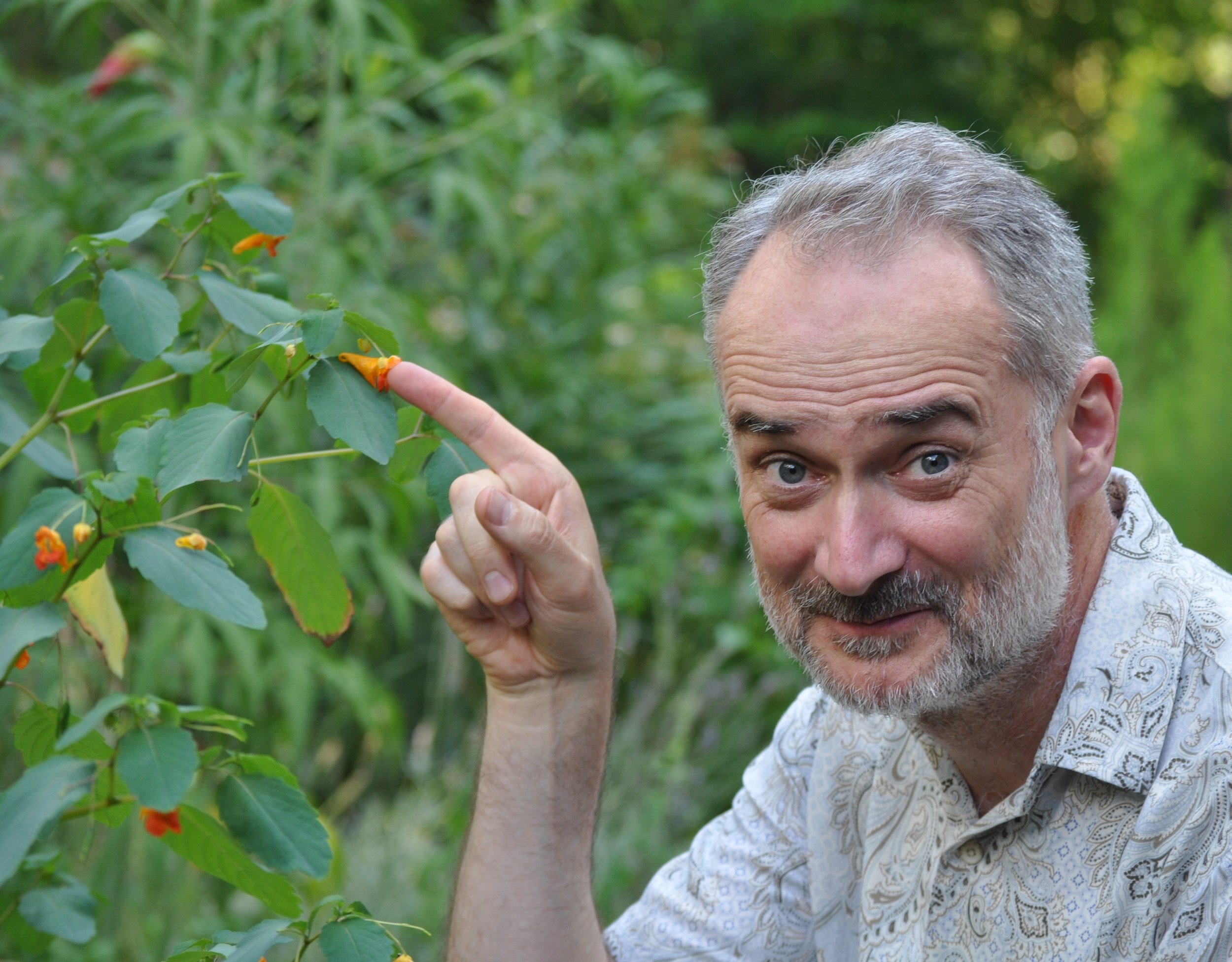
How have flowers shaped the modern world? Why do we and many other species have such intimate and long-term relationships with them?
On this special episode, we talk with David George Haskell, a writer and biologist. We discuss his most recent book, How Flowers Made our World, which explores the creative powers of flowering plants. Big Biology blogger and Biology PhD student, Clayton Glasgow, interviews David as an outreach project for the Young Voices of Science program. They discuss how flowers have played key roles in many ecosystems, the genomic innovations that underpinned the success of flowering plants, and the significant relationship between humans and flowers.
Cover art by Brianna Longo
-
Clayton Glasgow 0:05
From late April throughout May each year across much of Europe, male field digger wasps emerge from their burrows with one goal in mind: finding a mate. This goal is complicated, however, by the fact that female wasps don't emerge until a week or two after the males. A fact that the fly orchid is all too happy to exploit.
Marty Martin 0:24
The fly orchid, so named because to us the flower looks like a fly, actually mimics a female field digger wasp, and not just by sight. What really gets the males excited is the smell. Fly orchids emit a blend of aromatic compounds that precisely match the pheromones that female wasps release.
Clayton Glasgow 0:41
In fact, the match is so precise that among the hundreds of wasp species that occur across the fly orchid's range, the scent only attracts two species from the Argogorytes genus. The flowers and their scents are so convincing that male wasps zip right up and attempt to mate with the bloom, coating themselves with the orchid's pollen in the process.
Marty Martin 1:00
But a male field digger wasp is smart enough to remember and avoid the individual flower that first duped him. Unfortunately, subtle population variation in the orchid scent profile is often enough to tempt that same male wasp to a different flower, thereby fulfilling the orchid's sexually deceptive pollination strategy.
Clayton Glasgow 1:19
Fly orchids are far from the only orchid species to deploy such duplicitous deception. Among the 25,000 to 30,000 species of orchid across the world, nearly 1/6 use some form of sexual deception to attract pollinators. From the early spider orchid attracting male miner bees to the critically rare South African orchid Disa forficaria fooling male long-horned beetles.
Marty Martin 1:41
This diversity of orchid dupery is a primary example of the creativity and evolutionary success of flowering plants, which today's guest David George Haskell explores in his most recent book titled "How Flowers Made Our World: The Story of Nature's Revolutionaries"
Clayton Glasgow 1:55
David is a biologist and a two-time Pulitzer Prize finalist author. In his newest book on flowers, David provides a compelling account of how the evolution of these plants led to entirely new ecosystems, like grasslands, seagrass meadows, and tropical rainforests.
Marty Martin 2:10
Wait, flowers helped create rainforests?
Clayton Glasgow 2:13
Yes, which is part of the reason why David calls them nature's revolutionaries. The leaves of flowering plants carry vein networks and pores that are much denser than those of other plant lineages, like ferns or conifers, allowing flowering plants to move water and fix carbon at much faster rates. As these plants moved more water to the atmosphere, rainfall increased, helping create the conditions for rainforests to flourish.
Marty Martin 2:35
Ah, and once you have flowers, you get everything that eats them, and pollinates them, and hides in them and evolves alongside them. Bees, butterflies, ants, fruit-eating primates with color vision, including eventually us.
Clayton Glasgow 2:46
Exactly. Throughout the book, Haskell emphasizes that flowers are relationship builders. By creating and intensifying interactions with other species, Haskell writes that flowering plants turned I into we, and that they made success a community affair.
Marty Martin 3:01
Well now it's nearly impossible to imagine a world without flowers. Roughly two thirds of the calories we eat come from three grasses: rice, maize, and wheat. The bread version of that wheat is itself a hybrid of three different grass species with three genomes stacked inside it. Then there's tea and perfume and funerals and weddings. Just try to find a corner of our lives that don't have flowers in them.
Marty Martin 3:24
But before we get started today, I want to formally introduce the other voice you've been hearing in this intro, our blogger Clayton Glasgow.
Clayton Glasgow 3:31
Thanks, Marty. As the blogger, usually you're reading my words rather than listening to them. But today, I'm guest hosting my first episode as an outreach project for the Young Voices of Science program, a science communication training program for undergraduate, graduate, and early career scientists run by the Hubbard Brook Research Foundation. Special thanks to the Young Voices of Science team for their support, and to David for granting me this interview. And finally, one last thing before we get to the show: Are you an undergrad, MS, or PhD student in biology? We want to learn about your research for our student spotlight series.
Marty Martin 4:03
For a chance to be featured, send us a 60 to 90 second audio or video recording of you talking about your work for a general audience. Include your name, pronouns if you like, what degree you're pursuing, your lab leader, and your institution.
Clayton Glasgow 4:16
Send the recording, a high quality photo of yourself, and any social media handles you want us to tag to info at bigbiology dot org by Friday, September 25.
Marty Martin 4:25
We'll be sharing these spotlights on Substack and on our social media feed, and we'll also feature the clips at the start of some of our episodes.
Clayton Glasgow 4:32
It's a great opportunity to flex your sci com skills and practice a research elevator pitch.
Marty Martin 4:37
And now on to the show.
Clayton Glasgow 4:38
I'm Clayton Glasgow,
Marty Martin 4:40
And I'm Marty Martin,
Clayton Glasgow 4:41
And this is Big Biology.
Clayton Glasgow 4:55
David George Haskell, welcome to Big Biology. I'm really excited to have you on the show today. Talk about your new book, How Flowers Made Our World: The Stories of Nature's Revolutionaries I really enjoyed reading it. It's very well researched. It's very scientific, but it's also pretty fun and accessible to a broad audience. But before we get to the book, I'm wondering if you could give our listeners a brief introduction. You're a pretty well-known science writer, but you also have your PhD, so I'm wondering if you could walk us through your path into science and into science writing.
David George Haskell 5:26
Sure. Well, thank you, Clayton, for having me on the show. It's a delight to be here. Looking forward to our conversation. Yeah. So my path is wiggly. As an undergrad, I studied biology in the UK. My degree is actually in zoology, but my honor's project in the zoology program was studying rust fungi on blackberries, and so neither of which are animals. So I've always been interested in the breadth of life, and particularly how evolution and ecology kind of intersect to shape the world that we're in. From there, I went on. I came over to the U.S. where I've been now for more than 35 years. First as a grad student at Cornell, where I studied bird behavior and forest ecology, and then and then I taught at a liberal arts college at Sewanee in Tennessee for 29 years, and I'm now an adjunct professor at Emory University in environmental science. I stepped down from full time teaching, and I enjoyed that time teaching, and may get back into it at some point. But yeah, so at first, totally 100% biology, right? So from my undergraduate degree, and then PhD, and then after that, doing research into forest ecology and conservation, particularly using birds and sound as a way of assessing the health of ecosystems and collaborating with people doing GIS and economics to try and understand how biology fits into the bigger picture and teaching biology.
David George Haskell 6:53
But you know, I came to this point where I was like, man, there are so many amazing stories about, particularly the eastern forests in the U.S. about the trees and the soil and how the how the wildflowers interact with their pollinators, and we learn about all this stuff in ecology class, but that's sort of locked up in academia. A very small number of people in a very sort of generally pretty narrow slice of age groups who get the privilege of of being in that world, and so I wanted to to expand, if you like, the the storytelling beyond the classroom, and and wrote a book, and now several books about largely about how ecology and evolution fit into our everyday experience of the world, how our world is is shaped by deep time and also by present day ecological interactions. And for the last ten or more years, I've been pretty much full time as a writer, both of books, but also guest essays, multimedia experiences, and so forth with magazines and other publishers trying to puzzle over and to celebrate and to mourn and to stimulate curiosity about the living world.
Clayton Glasgow 8:07
Yeah, that's great. Thank you. I'm an aspiring graduate student myself, and so it's always I always appreciate hearing the paths that people take because they're pretty varied, and also encouraging to hear that academia is one path, but it's not the only path for folks who do graduate work or are super into science.
Clayton Glasgow 8:24
Let's move on to the flowers now because that's the whole story of your book. And in the book, you describe them in ways that I really like. You call them "world makers" or "world changers". Maybe my favorite was unifiers of realms. Thought that was a clever phrase. And I've got to say I've definitely started to pay more attention to the flowers that I'm seeing as I'm just walking around. It's you know good timing with the publishing, right? As the spring flowers are coming out. I'm in Ohio right now, and I've been really impressed with the flowers on the Ohio buckeye tree. They're these sort of like coat. They look like mini trees on the tree itself. These cones of cream-colored flowers, which is really awesome. But I'm wondering if you could start by telling us why you chose flowers as the subject for the book and what drew you to the flowers?
David George Haskell 9:11
Yeah. So you know, over the years, again and again, I keep coming across stories, and not just stories, but also sort of realizations in my own work of how important flowering plants are, and flowers to how the world came to be and how the world functions. And yet paradoxically in our culture now we tend to regard flowers as, yeah they're pretty, they're beautiful, but they're not particularly powerful or in charge. So I wanted to write this book to put flowers back at the center of the story of how our world came to be, because once they showed up and they were late arrivals on planet Earth, they really did overturn the old order of Earth and many ecosystems. In fact, many of the most important ecosystems today are founded on the productivity and diversity of flowering plants. So there's an amazing story, literally, of how the world came to be, at least the modern world came to be, and this is a story of delight because humans, our senses are attracted at least to some kinds of flowers, right? Some others we're repulsed by, like the ones that smell of dead animals because they're trying to attract flies and things like that. But you know, even that is kind of fascinating. I was just at the Missouri Botanic Garden and heard that people were queuing up till three or four in the morning when the corpse flower was in bloom. So this is a flower that really stinks, you know, it doesn't smell pleasant, but people are absolutely fascinated by it and willing to stand in line for a long time to get a sniff and to get a look at this amazing giant flower that only blooms, you know, very very occasionally. So it's definitely a special occasion. So part of the book was to think about the intersection of human aesthetics and beauty with these bigger pictures of ecology and evolution, and then looking to the future of you know what does the future hold for the world and flowering plants and humans and how we're all entangled together.
Clayton Glasgow 11:05
Yeah, what I think the book does really well is it interweaves that story of their evolution and their ecology with also our relationship with flowers and how and and we'll come back to this in a little bit. We interact with flowers a lot more than we think we do. At least that's one of the takeaways that I had from this book - is that flowers are sort of hiding in plain sight in a lot of ways. Before we go any further, though, could you? We all have an image of what a flower is, but could you define, ecologically speaking, what a flower is?
David George Haskell 11:34
So, flowers, botanically, their defined, the scientific term is angiosperm, which means a plant that holds its seeds within a vessel. So technically, flowering plants as a group are defined by the fact that their ovaries mature into fruit, which hold the seeds, and that's a form of botanical motherhood. So that's one of the inventions of flowering plants, actually, is to have greater intergenerational generosity, if you like, by expanding their motherhood, wrapping all their seeds in fruit in a way that no other plant does. And then that fruit is the mature result of the sexual parts of the flowering plants, which are petals or various other structures that are like petals that generally enclose both male and female sexual parts that are producing pollen and eggs. In a small number of flowers, the sexual parts are separated into different flowers. But for 90% of flowers, it's they are biologically bisexual, meaning both pollen and eggs are produced in the same structure. And those petals and associated structures are often very much about advertising, about producing colors and shapes and aromas that are going to draw in pollinate. There's mostly insects, but also other creatures, sometimes birds and bats, and even some mammals. So that one way of thinking about flowers is that sexual part, the sexual parts that then mature into the fruit and help the young onto the next generation. But more generally, there's this term flowering plant, which is the whole rest of the plant, the leaves and the stems and the roots that exist from an evolutionary point of view to support the reproductive parts. Right, ultimately, just looking at things through the lens of evolution, the point of a leaf is to produce and to support an organism that can then propagate itself into the next generation. So the whole flowering plant is, in a way, exists, in service of that maternal and paternal drive to spread the genes into the future. And so, yeah, flowers are the things, like a rose or a lily, things that we might buy in a florist shop. Those indeed are flowers, but also the rest of the plant, biologists call them flowering plants, and sometimes the word flower is just used as a shorthand for the whole plant as well.
Clayton Glasgow 13:57
That's great, and will be useful context. And you mentioned some of the things that make flowers so unique and creative, and one of the things that you discuss early on throughout the book when talking about their evolution is this idea of genome duplication and how important that was in the evolution of flowering plants. You have this line that you sort of used to summarize it very succinctly, which is: "copy all, paste, and then delete selectively" when it's coming to those genomes. So I'm wondering if you could explain a bit why plants duplicating their genomes helped spur the evolution of flowers. And if I'm understanding it correctly, why flowering plants might be more likely or more able to undergo that sort of genome duplication.
David George Haskell 14:41
Yeah, so genome duplication is when, as you say, when the whole organism makes a double copy, sometimes more than a double copy of all the chromosomes. So generally, that means instead of having two copies of every chromosome in every cell, like we do, and like a lot of plants do, they now have four copies of every chromosome. And other organisms do this as evidence that some of our ancestors way back when our ancestors were fish went through a couple of rounds of this whole genome duplication, and ferns certainly have gone through non-flowering plants have gone through these these rounds, but it seems especially important in flowering plants because it happens a lot and has been an engine of diversification and of innovation. And how that happens is you double all those genes. You got four copies of every chromosome. That is totally excessive. You only need two copies to run the plant. That means the others, the duplicates, the other two copies, are free to mutate and explore new ways of doing photosynthesis, new ways of producing aromas or of moving water through their bodies, and so anything that a gene can influence in the plant is potentially influenced by, is potentially affected, by the by these gene duplications. So it's kind of like a cross between a rave and a corporate brainstorming retreat. It's like the usual rules are suspended. Let's just go crazy with innovation. And of course, genetic diversity is the raw material of evolution, of natural selection, of adaptation, of resilience. But it's not enough. What you need after this duplication and exploration, which is great, you then need the cold winds of Darwinian selection, which come through and trim out a lot of the excess, because a lot of those mutations are going to be unhelpful, neutral, just kind of junk in some way. And so, flowering plants have been really great at then purging the genome of parts of those chromosomes that aren't serving the organism very well, but keeping the good ideas. Like say, if there's some mutation that allowed a new kind of photosynthesis that was really useful, then that is kept, and the rest is thrown out. And eventually, over hundreds of thousands of years, these plants get back to having just two copies of every chromosome.
David George Haskell 17:11
So, yeah, you double the genome, you experiment, but then just as important is the severe trimming back of this. And there's evidence that flowering plants have been through this multiple times, particularly in calamitous times like when a meteorite hits the Earth, but also in more everyday times when new plants when plants find themselves in new environments. And it, you know, it's a little bit of a puzzle why flowering plants are so good at this, whereas other plants aren't, and a lot of it comes down to the trimming. So some ferns, for example, have multiple, have duplicated their genes and their genomes many, many times, and have enormous, great nuclei. So much, I mean, just so much. It's like an episode from some hoarders TV show, right? They've got so much DNA, and maybe that's okay if you are living in the shade and you're growing slowly and, honestly, dividing your cells really rapidly is not particularly super important for you, so that works. But for flowering plants, trimming back means that they can keep their cells very small. They can have very high density of veins in their leaves because they've got lots of small cells. They can have lots of breathing pores. So trimming back and keeping the genome and therefore the nucleus and the cell quite small has been very important in flowering plants.
Clayton Glasgow 18:38
I've found that part super fascinating and is something that I hadn't really heard about before, and I think you give an example in the book of that duplication happening via hybridization between species. Is that that's clearly a way that it can happen? Is that the primary means by which it happens? Is through hybridization, or are there...?
David George Haskell 18:59
No, there are actually the two primary means. One is just all, just without any kind of hybridization, just all the chromosomes duplicate, and you have a duplication that's happening within a species. So that's one route. And then the other way is when you have hybridization between usually two fairly closely related species. And a famous example are the goatsbeards or salsify. The scientific name is Tragopogon. These are like badass dandelions. They have huge. They're like dandelions on steroids with kind of big puffy seed heads, and their and their flowers are like dandelions, but a lot more spiky. And there were three species that lived in Western Europe, mostly separate from one another, although there's evidence of some hybridization back in Europe. But then they all got imported into the Western U.S. when European colonists dispossessed indigenous peoples of their land and turned much of what is now Eastern Oregon, Eastern Washington into wheat fields. And these goat's beard plants came in and were suddenly growing in the same railroad sidings, the same ditches, the same field edges, and they hybridized. And some of them, through that hybridization, then doubled their genome, and because of that, formed entirely new species that are now actually doing quite well, not just in Oregon and Washington, but in other Western states.
David George Haskell 20:24
And what was amazing about this is that there was a botanist, Marion Ownbey, who was at Washington Washington State University, who was there and kind of collecting plants and documenting this and studying it in real time. So this became in the early 20th century a classic example of speciation through hybridization, and it's in a lot of textbooks, and it's kind of a famous example because it came along at a time when some critics of evolution were like, "Yeah, this is a good idea, but show us some actual examples of new species forming. And along comes Ownbey, and he's like, okay, here's one. You can come and you can come and visit here over in Eastern Washington and actually see that see these plants growing and and study them hybridizing in real time.
David George Haskell 21:12
So that is one particularly famous example. But I should say, the examples that should be more famous are most of our food crops, like wheat, bread wheat, and lots of other crops are actually have got doubled or tripled genomes in them. So our ancestors, even though they didn't understand and didn't have genetic sequencing machines, right, like the way we do now, they understood the plants very, very well and picked out those variants and maybe did some interbreeding of their own among different varieties and species of potential crop plants, and the ones they selected to use as crops turned out to have double genomes, which gave them new things like more nutritious kernels, or they grew bigger, or they were better in in dry conditions, things like that.
Clayton Glasgow 22:11
I'm glad you brought that up because that's where I was starting to head next with this idea that we mentioned, where we're interacting with flowers or flowering plants a lot more than we think we are. I had never really thought about grasses as flowers or flowering plants, and so that was a reframing. And of course, a lot of our foods come from these big grasses that you just mentioned: wheat and rye and rice and oats. And part of what you were saying in the book is, and what we mentioned earlier, this term for flowers as world makers or world changers because they build communities and sort of create these relationships. And you you go through a lot of the classic examples of pollination with orchids, but I was I was particularly interested in this section where you talk about grasses and fire and mammals and how flowering plants created this system that most people probably don't think of as a system that was created by flowers. So, so can you walk us through that system of grasses and mammals and fire depending on each other?
David George Haskell 23:13
Yeah, yeah, it's a fascinating story, and we are one of the great beneficiaries of that. But the story starts long before humans or even human ancestors were around, and indeed, as you said, most of us don't think of grasses as flowering plants because they don't make conspicuous flowers. They're mostly pollinated by the wind, and yet they're flowering plants nonetheless. And anyone who has aloud quickly knows in the late summer, right? There's a lot of pollen, and those are coming from flowers, that pollen is coming from flowers on the grasses. And grasses are kind of sneaky. They've sort of triumphed by having a very humble body plan. They keep their growing tips and all the sensitive embryonic tissues in the ground or creeping along the ground, and then they send up these disposable leaves, right, blades of grass that are great at photosynthesizing and all the rest. And then some of them, late in the season, they dry out, and instead of just dropping the leaves, the grasses let them stand, and this, in a way, is invoking fire. This is a plant that creates its own kindling, because when a fire comes through a grassland, it burns off the top parts of the dry grass leaves, but most of the grass isn't harmed because its roots and and its stems and everything are creeping along the ground. So the grass clears its competition because the brambles and the saplings and the trees all get burned up in that fire and eliminated, and the grass then next spring just resprouts, feeding on the ashes of its competitors.
David George Haskell 24:48
So this is a kind of evolutionary agency where the grasses essentially expanded their range and took over a lot of the planet by being the green Prometheus, stealing fire from the gods and using it for their own purposes. I mean, not every species of grass does this, right? There are some that hang out in the shade of forests and things like that. But the ones that formed the prairies and the steppes and the savannas basically were the first big deforesters of the planet, right? They pushed out the trees and the forests. I mean, they had some help when the climate cooled a little bit, so that helped. But they made a lot of this happen by working first with fire.
David George Haskell 25:29
And then after fire and grasses start working together and supporting one another. The ancient mammals that previously were living in the forest, browsing on trees, some of those moved into the grasslands and evolved into grazing mammals, and there's a great fossil record in lots of different groups, like the groups leading up to the horses, showing the gradual evolution of teeth and mouths and body structures that are adapted to grassland, including, say, in the horses, evolving the ability to run very very fast and for long distances over the grasses, which you can't do, obviously, in the forest. Nobody races browsing mammals; you race grazing mammals because they're grazing on grass. So a whole host of mammals evolved and became part of this relationship. So now you have a triad: grasses are helped by fire, and fire and grasses together help these grazing mammals, and the grazing mammals help sustain the grasses. So they're all supporting each other by working together and sustaining these grasslands.
David George Haskell 26:36
One of those grassland mammals were our ancestors. The five, six million years ago, some of them left the forest, wandered out into the grasslands, and eventually, these are pre-human hominin ancestors. Eventually, some of them became bipedal and figured out how to work with tools and things like that, and some of those evolved into modern humans. But these were grassland animals, so we owe our evolutionary origin to grasses 100%. In fact, when our ancestors really started specializing on on particular kind of tropical grasses and eating the animals that eat those tropical grasses, is when our evolution, our brain size, and our use of fire and so on really really took off. And to this day we're still grass apes. I mean, most of our food comes from grasses, one way or another. Right, two thirds of our calories are corn, rice, wheat, and then others are sugar cane, pasture grass, feeding animals, oats, millet, barley. All of these are grasses. So if we were named for our diet, we'd be called grass apes, and if we were named for the habitat that created us, we'd be called grass apes too.
Clayton Glasgow 27:47
That's great. Thanks for going through that. And of course, in the past few centuries, we've there have been a major declines of these large mammals that you mentioned that are so important to these grassland systems, as well as, especially in the United States, just major suppression of fire, and so how how have these systems been responding to to these pretty dramatic changes over the past few centuries?
David George Haskell 28:12
Yeah, and plowing up a lot of the grasslands for you know row crops.
Clayton Glasgow 28:16
Right
David George Haskell 28:17
Yeah, so it's a complex thing. So as humans spread around the world, coincident with some pretty dramatic changes in climate, right when the last ice age was ending, there were mass die-offs, and there's a lot of debate about, you know, were humans responsible for the mass die-offs of grazing mammals, or was it more climate change? Maybe it's some of both. Regardless of the cause, the grasses lost a lot of their grazers, and as you would predict, then fire really took off because the fuel load in a lot of places really became huge. There weren't any mammals clipping back the grass, and so that with fire when it came really had a lot to work with, and so for for a short time you see a huge increase in in fire and some of the, you know, soil deposits from that from those times are really kind of blackened by all the fire that came through.
David George Haskell 29:09
But then, as human populations spread, I mean, the story is different in different continents, depending on what people's relationship with was with the land. In some places, we humans actually helped at least some grasslands by clearing a lot of forests. Say in Western Europe, clearing a lot of forests to produce meadows and pasture lands, and then also plowing it up to make row crops. Which, depending on whether it's a meadow or a monoculture of wheat, can either have very high biodiversity or low biodiversity. In North America, the usual statistic that's bandied about, and I don't know the precise number here, but you know maybe about 1% of the original grassland prairies are left in the in the USA, and that's mostly through conversion to intensive agriculture by by plowing or by massive overgrazing, and so both of those things have really modified grasslands. Particular, I mean, in the U.S. it's a very dramatic story of transformation. But this is true actually all over the world that either through overgrazing of domestic mammals or through plowing, most grasslands have been quite severely impacted, so particularly in North America and in the U.S., especially, there's been a lot of loss of grasslands through mostly through conversion to row crops through plowing, but also through overgrazing, and that's a story that's actually repeated over a lot of the rest of the world. If you document just the state of grasslands across the planet. Overgrazing and plowing are two of the main pressures. And you know, it's up to 30% of the terrestrial surface of the planet is some form of grassland or another. So these are major habitats that are feeding humans, but they're also really, really important for a lot of biodiversity, for charismatic mammals and so on, of course. But also particularly for insects, for soil microbial diversity, for other flowering plants like many orchids, other flowering plants depend on grasslands to actually have full and rich ecosystems.
Clayton Glasgow 31:39
Absolutely, I think they're also pretty good carbon sinks as well. I think they suck up a lot of carbon as well, and then store it under underground.
David George Haskell 31:47
Absolutely, yes. I mean, so forests are grasslands. Many grasslands are, and then the real champions are the sea grasses and the mangroves and the salt marshes that really suck up a lot of carbon from the atmosphere and store it for a long time.
Clayton Glasgow 32:01
Yeah, actually, I don't. I don't think we'll quite get to the seagrass part of the book in this conversation. But I encourage listeners to go and read that part. We'll read the whole book, but read that part because seagrasses were also not not on my list of flowering plants that I was aware of before the.
David George Haskell 32:18
They're awesome. Yep.
Clayton Glasgow 32:20
Yeah, they are. You end the book sort of with this section on speculative futures. You take a gander at looking into what is to come, just in terms of climate change and global environmental change more broadly, warmer temperatures, some degraded soils, and you give sort of a shorter-term and longer-term outlook, but I'm wondering what can you give us an idea? What's the outlook for flowering plants in a world changed by human activity?
David George Haskell 32:53
Yeah, so the emphasis is on speculative because the track record of humans predicting the future beyond a few weeks, you know, ahead is like really really bad. I mean, you look at how people in the 19th century were thinking the world would be. Even people, say in the 1980s, looking to our present time, there is just whole load of technologies and cultural changes that they could never have predicted. So, when we're looking centuries or millions of years into the future, it's we're in this realm that is partly sci-fi, in my opinion, but also worth putting our head into. And in the short term, what we can say by looking at current trends is that many flowering plants are in are in deep trouble. Right, so about 40 to 50% of flowering plants around the world are threatened with extinction one way or another, mostly through habitat loss, through overexploitation, through novel diseases, some through climate change and its effects, which will become more of an issue as the decades roll on. So that's one part of the story, and of course, what we need to do to reverse that is to protect habitat and reconnect formerly fragmented habitats.
David George Haskell 34:04
But then there's another group of flowering plants that are actually doing quite well, and those are the ones that have rapid generations and can evolve very quickly to meet new conditions, even in super poisoned places like old mine sites that are full of heavy metals, or along the sides of busy highways where there's all kinds of runoff. There are a small number of flowering plants that have evolved the ability to either detoxify the toxins, to work with fewer pollinators, to work with new pollinators, to find ways of life that fit them into this new world. So even in the places where we have done our very best to create a moonscape, flowering plants have, within a matter of years, at least some of them have been able to reestablish life in those places. So we humans will not have the last say. There will be flowering plants around on this planet long after whatever we turn into has evolved, or if we go extinct, or leave the planet and go and join the techno fascists up on Mars, or whatever it is-I don't know what our fate is. But flowering plants have been here, revolutionizing the world for 100 million years, and they will continue to be here well into the future. So, in the short term, those those "weedy" species, and weed is a difficult word because often it's used in a pejorative sense. But actually, weedy plants are some of the most creative plants that are out there. I really really admire them. So some of those plants are doing well and will continue to do well. And then other plants are going to struggle unless we make the choice as we should and as I hope we will to be better neighbors and kin to the rest of life, so that's the short term.
David George Haskell 35:45
In the longer term, it gets kind of crazy. It's like, what would the world be like in 50 or 100 million years from now if humans continue to degrade soils around the world and make the world hotter and more fire-prone. Well, it turns out we've got places on this planet where flowering plants have been living on very old, nutrient-depleted soils, very hot places, generally pretty hot at least, and with a lot of fire. The Cape region of South Africa, some parts of southwestern Australia, are meet exactly those criteria and have ecologies that are actually very different from, say, much of Western Europe and North America, where we live on generally pretty young soils, and we and it's very geologically active with all kinds of big rivers and mountains moving things around. That's a different ecology than soils that have stayed in place for literally millions of years, and the plants have had to adapt to them without this continual sort of geologic refreshing. The floras in those places are some of the most diverse, exuberant, and deeply connected with animal pollinators that exist anywhere on the planet, I mean they're sort of world famous for this, and so it is possible that in the long term, even if humans do our worst, and that in the very very long term, flowers will be able to repopulate the planet with this sort of glorious exuberance of floral form. In no way whatsoever does that justify our improvidence with climate change, paving over the world, causing species extinctions, right. Just because poppies bloomed after Western Europeans bombed the heck out of each other for four years during World War One; those fields churned up by shells were full of flowers. Just because that was amazing does not justify the bombing in the first place. So the fact that in 50 million years it is possible that there will be floral beauty on this planet, even in degraded places, does not mean that we should continue degradation. In fact, quite the reverse. To give evolution the best chance to continue working, producing a diverse, thriving, vital planet, what evolution needs is diversity of species, genetic diversity within species. So, protecting habitats for me, yeah, it's about protecting the legacy of past evolution and protecting the modern diversity of the world, but it's mostly about protecting the raw material and the potential for evolution for the future.
David George Haskell 38:34
So that's part of my sort of speculative riff on what could happen in the future that then kind of circles around to what should we be doing now, which is taking care of the incredible diversity that we have now, not only for our own sake as a human species, because we, without plants, we're done for, especially flowering plants and especially grasses, not only for the sake of flowers in the present moment, but for the sake of the future beauty and vitality and diversity of the earth, whether or not there are humans around there to appreciate those flowers.
Clayton Glasgow 39:10
Yeah, absolutely. That's all really great, and I just want to return to a second for the weeds. I teach high school science, and every week I introduce my students to the just a local species of the week, and it's dandelion season. So this week's was dandelions, and I a lot of students be like, "Why this is a weed? Why are we talking about dandelions? I said, "Well, there's a lot. Dandelions are pretty awesome, and now I have to introduce them to the goatsbeard that you mentioned and show them some pictures.
David George Haskell 39:38
Oh yeah. I love that the fact you're doing that because one of the things that our education system is so bad at is increasing familiarity with local species in our environment, right? So the SATs, the GREs, they're all about sort of abstract knowledge that applies uniformly everywhere, which is fine to learn some of that. But man, how can we be good human beings on this planet without knowing how to identify some local species and learning the songs of a few birds and so on? And it's not like everyone has to be an expert in this, but just a basic kind of familiarity is not only sort of good in that we'll be better kin and neighbors, but we'll be more joyful because that's kind of fun to know that
Clayton Glasgow 40:22
When they learn a new species and then are able to identify it outside and show me a picture, that is definitely joy.
David George Haskell 40:28
Yeah, and you're restoring part of their humanity because what is our inheritance as humans is to be in relationship with other species, and when we lose that, we've literally lost something that have sustained our ancestors for hundreds of thousands of years,
Clayton Glasgow 40:43
Which ties in nicely to this next part as we sort of wrap up the discussion of the book itself. It's definitely a science book. You talk a lot about the ecology and evolution of flowering plants and their interactions with other species and the way that they generate diversity and have all these fun genome duplications, etc. But a continuous theme throughout the book is humans, our relationship with the natural world, flowers in particular, but also more broadly. And I think you make a case that flowers could be really important as a tool to help repair our relationship with the natural world. Could you elaborate on that a little bit? What role or how can flowers help us become better stewards?
David George Haskell 41:27
Yeah. I mean, first, I mean, about the book. For me, the book, yes, it's about the scientific stories, but it primarily it starts on the sort of sensory richness and diversity of flowers, a celebration of that, and then following that back into the scientific stories. So, connecting everyday experience, say of roses, back into the story of well, what is a rose, and why are we so fascinated with them? Yeah, so flowers, when they first evolved, you know, one of their great sort of innovations was to speak to animals in a language that animals really relate to, right? And mostly the animals they were speaking to are insects, and they do that through colors and aromas and shapes. And it turns out we humans are also fascinated by that. And think of all the places that we use flowers, you know, at weddings, when we're decorating altars, when we bury someone. So at each major transition in our life, we're bringing flowers in. So in our subconscious, we do kind of understand that flowers are really, really important, and so we have this aesthetic connection to flowers that isn't just about oh they're pretty and that's it. It's like no, they're purity, they're beautiful, and that teaches us something about the nature of life, right? That flowers built the world, and that are important not just as symbols of the continuity and the vitality of life, but they're actually the foundation of the continuity and vitality of life, which is why it's so poignant to bring flowers to a grave, right? In that, in that there's a big ecological truth being told in the particularities of the massive grief we feel for that one person that we're burying. And the same thing-the joy when people get married and there's flower petals everywhere. It's about that individual couple, but it's also about the bigger story that flowers unite, stitch the world together in that way.
David George Haskell 43:14
So they're great ambassadors, if you like, for increased awareness into the natural world, and you know, there's a little bit of a mystery here. Like, why is it that as humans we're not pollinators, right? And yet we're fascinated with flowers, and I think it's telling us something about our inherent need to be in relationship with productive and beautiful habitats. And then on the aroma front, you know, putting on rose perfume and so on. When we want to express our individuality, or putting on floral prints, or a shirt that has flowers on it, or a necktie, or something. Weirdly we become hybrids. I express myself by hybridizing my appearance or my aroma with that of a flower. So I becomes a we. The self expands into a community, and really that makes me more myself. It makes me more feel like I'm expressing my individuality, and you know that's kind of the original genius of flowers is to is to expand the self into the community. That's how they built incredibly productive ecosystems. That's how they managed to, I mean, like there were no tropical rainforests, no flowering plants, no prairies, and so forth. And a lot of that is built through community building. So our cultural rituals, in a way, echo those bigger, bigger stories.
Clayton Glasgow 44:32
Excellent. And yeah, the section on aromas and perfumery it made made me chuckle because being around a bunch of teenagers who are going through adolescence, that the amount of perfume and aroma that they apply on themselves is outstanding. And my guess is they're not thinking about flowers when they do that. But I'm gonna start telling them about their flowers that they're putting on.
David George Haskell 44:56
Yeah, flowers and you know other botanics. Like wood and you know, and then other aromas. There are some animal aromas that are applied. Of course, a lot of it is synthetic imitations of that these days. But each one of those aromas actually often has a really ancient story. Like people have been working with roses for at least 3000 years, probably longer. And some of the other more woody, resinous perfumes date all the way back to ancient Egypt, where people were using them in rituals and funerary rites and religion. So even in a bottle of aftershave or of perfume, you know, from CVS or you know the corner drugstore, has got amazing stories about both biology and human culture embedded with it.
Clayton Glasgow 45:46
We'll pause there for the book itself, and again, I encourage our listeners to go pick up a copy. It's a really great book, and I'd like to, before we end, take a few minutes to just talk about your work as a science communicator, a science writer, in a time when that is super important with climate change and biodiversity loss and just a lot of misinformation. How do you approach that work, and how do you decide the topics that you choose to write about?
David George Haskell 46:13
Yeah, I mean, so for books, yeah, a book is a multi-year commitment, right? So most of my books take probably like about five years to write, and then I spent several years afterwards talking about the book. So, you know, I use my gut to figure where is there an intersection of lots of stories that are really about interconnection, they've got all kinds of cool scientific information, maybe that's been recently discovered, but also stories of human culture and where all of that wraps together, it feels like okay I'm going to try and write a book, say around how flowers made our world. And then the approach with the books is is starting with sensory connection, right? So if I could like if something as abstract as genome duplication, oh my god, it's like yeah, I mean, so I mean that's fascinating, but we've got to invite people into that understanding. So, talking about how these, my personal experience with these goatbeards growing as weeds along the sides of roads and trails, and in the community garden in Colorado, and how, you know, particularly during the COVID sort of lockdowns, for me, they were really I loved them because they were like these explosions of color, and they just felt very defiant. And so, you know, getting up close and personal with things, and sharing some emotion, as well as information, and then talking about okay, this plant isn't just kind of cool because it looks like a badass dandelion, it's cool because it is one of the most rapidly evolving creatures on this planet, and in its story, we can see the ancient story of how flowers came to take over the world in just a few million years. So those are the kind of, you know, if there's any sort of repeated theme in my work, it's connecting the sensory world to the stories of deep time and of ecological interconnection.
David George Haskell 47:51
And I'm honestly not particularly motivated by trying to counter misinformation and things like that, because honestly, that misinformation this week is going to be something different next week, right? And so, a book length project is more about celebration of the science and of and looking at the cultural stories, some of which are really beautiful, others are pretty horrific, like Linnaeus writing white supremacy into the foundations of biological classification. That's a story that also needs to be told, so that we can make sure that we realize what the historical roots of science are, and to identify modern racism and sexism and other forms of prejudice that are dressed up as rigorous science, but in fact are not. So that's part of the story that I'm telling in these books.
David George Haskell 48:27
For other things, you know, I work on short essays for newspaper, sort of longer things in magazines that tend to be focused on issues that I find particularly compelling for the moment, right? So how do we, for example, bring back the celebration of the more than human world into human rituals. Like Christmas trees, right. What's that about? Like why? Why do people bring trees indoors every? And it's sort of about Christmas, but really, it's got like nothing. There aren't any Christmas trees in the Bible, as far as I remember. So, these rituals that we don't often think about in an ecological context, I think, can offer an opportunity to kind of expand our imagination out into the more than human world because bringing greenery inside during the darkest time of the year is actually a profoundly ecological thing. And particularly when it's associated with gift giving, that at the time when I should be seemingly hoarding stuff, like so, when the winter solstice hits, that's a time when we are about to go into several months of like very little food around, right? That was the experience of our ancestors. I mean, anyone who didn't live on the equator-that was the experience. And what do we do in response to that? We gather in celebration and we give each other gifts. So generosity in response to scarcity. Wow, that is that's an interesting cultural lesson, but it's also an interesting ecological lesson, and it's all tied up with Christmas trees.
David George Haskell 50:27
Or, you know, there are, in other traditions, there are other, say, Hanukkah in Judaism is about olive trees and the generosity of olives all around the Mediterranean. And the incredible, you know this tree that seems like it, you know it seems all wizened, and how can be much food on that? Well, in fact, it sustained civilizations for thousands of years all around the Mediterranean. And at Hanukkah we remember that oil in the olive oil lamps that should have burned out in just a few hours kept going for days and days, so it's a miracle. It's about God, but it's also about olive oil, and olive oil appears again and again in scriptures, right? The word Christ means the Anointed One, anointed with olive oil. And in Islam, God is compared to the lamp, the light of an olive oil lamp, right? And so, yeah, some of this is metaphor, but a lot of it actually has some deep ecological truths about people's reciprocal relationship with trees in the Mediterranean.
Clayton Glasgow 51:30
Amazing, yeah, I love that theme of reciprocity and generosity as a response to the natural world.
Clayton Glasgow 51:32
A lot of our listeners are students, undergraduate or graduate students who might be interested in science communication themselves. So, what quick advice might you offer to them if they want to try science writing for a more public audience?
David George Haskell 51:50
Yeah, I would say experiment, go for it, right? And there are lots of different ways of telling stories. I mean, on various social media platforms, writing for local newspapers, for student newspapers, writing op-eds and sending them into regional or even national newspapers. I mean, the New York Times has published several op-eds written by undergrads who have a particular, say, about undergrad admissions process or the experience of being an 18-year-old today, and so forth. So, so there are there are opportunities of sort of getting involved with that, and you know my own approach, certainly early on, but still to the present day, is to just goof around and play with it and see what works. Yeah, some of it's going to be hard work. It's going to be frustrating. I mean, my first book, we got told no, nobody wants to publish this at least 50 different times. But persistence, right? So keep at it. You know, keep going to the 100th rejection and just keep plugging away, and eventually you'll find success.
David George Haskell 52:43
And the other thing I would say is be true to yourself. We each have our own way of our own personality, our own thing that we're super into. Doesn't mean don't learn new things, but listen to that inner guide and have enough quiet space in your life to know, yeah, you know, this feels like I'm really selling out, or this feels like just I'm trying to force myself to be someone I'm not. Like, I mean, we all feel this like from social media influencers, right? Oh man, they've that science communicator's got like half million followers, and so I'm going to try and be that person. It's like no, that I just got to be myself, and you know, if people are interested in that, great, and if not, no worries, I'm not going to force myself to be something I'm not. So that's a sort of key thing, and it's hard to know who we are. I mean, like you could spend years in therapy and still not know the answer to that, but we all have a gut sense of things that feel like, oh, when I'm doing this, it feels like at least some things in my life are aligning, and this feels like it's working for me. When we're starting out, a lot of us have imposter syndrome, insecurity. It's like, just forget all that. I mean, I have it now. I'm, you know, I'm getting nervous about all kinds of stuff and feel like, what right do I have to talk about any of this? It's like, well, let me think about that. Make sure I'm not appropriating, you know, abusing my privilege, all of that. But also, like, some of those voices are just me trying to shell myself in, and sometimes I've at least have got to be like, okay, now I'm going to go out and take some risks, experiment, treat it as sort of a playful activity, and figure out what works for me. And for some people, yeah, it's going to be forms of science communication. For others, honestly, it's going to be say being a teacher, which is 100% science communication, right? Live, in person, one on one with the same group of people for an entire semester. That is the most, I think, the most powerful form of science communication, which is why I was a teacher for many, many decades. And for others, might be being a researcher, right? Not everyone needs to be telling the story. Some people need to be diving, their thing as just focusing on one scientific question for like a whole decade, and then really working in there, and they feel no attraction whatsoever to any kind of communication outward, and that's okay. Like a healthy ecosystem needs lots of different species doing different things. So does human culture. So that's part of the inner discernment as well as being okay with not being everything, right? You know, and I've had in saying yes to some things, we necessarily have to say no to others because we don't have unlimited time and energy. That was pretty rambling, but that's you know those are some random bits of advice, I guess.
Clayton Glasgow 55:31
Great. A few quick questions. First, I'd be remiss if I didn't ask you if you have a favorite flower after writing this book?
David George Haskell 55:37
Yeah, I mean, usually it's the one I'm looking at at the moment. The one that transformed, that was most exciting for me and transformational were the sea grasses. These are flowers that bloom under water, and they're the most inconspicuous, boring looking flowers in the world. And yet, they're the world's champion carbon storage and biodiversity creation creatures in the most humble habitats possible: mud flats and stinky kind of sulfurous places. So I thought they were awesome. You know, I love the roses and the magnolias and all of that, but the plants that upend my expectation are kind of favorites.
Clayton Glasgow 56:13
Awesome. And if you could say, is there anything that you're writing next or hoping to work on next, or any ideas for what you might a new topic that you might explore?
David George Haskell 56:22
I mean, I'm continuing to write for magazines and other things about flowers, so that's going to continue for a bit. I've been thinking quite a lot more about this question of beauty. What does beauty mean in the world, right? So often in science, we think it's just superficial and subjective. Well, beauty is one of the most motivating things we can feel, but it can also be deceptive, right? So, how do we deal with beauty in relation to science? So, finding some, you know, that's a pretty abstract idea, but finding some, you know, working with some concrete ideas around that.
Clayton Glasgow 56:55
Yeah, I recently read Michael Pollan's The Botany of Desire and he talks a lot about beauty, and that was a fascinating book as well. Well, great. But before we wrap up, just want to give you the space. If there's anything that we haven't covered that you like to mention before we go?
David George Haskell 57:08
Yeah, I just encourage people to go and find a flower somewhere this week and just spend 10 minutes with it and consider the world from the flower's perspective. To whom is this flower speaking? How did it get here? Who are its friends and collaborators and enemies, just trying to unself yourself into the flower, even a cut flower on a vase, you know, on a kitchen table, or a flower on like the cover of a book or on the dress. Like, what's this flower's name? What kind of aroma does it have? Why is it the shape that it is? So that can be a really, it can be nice kind of chill activity to do a little meditation with a flower, and we all need a little bit more of that in our lives. But also, it's a great way to sort of befriend and come to know and be curious about the floral world.
Clayton Glasgow 57:53
Excellent. That sounds like something I will have my students do next week.
David George Haskell 57:58
Excellent. Great.
Clayton Glasgow 57:59
Yeah. Well, thanks so much, David, for your time. It's been great to talk to you. I enjoyed, really enjoyed the book.
David George Haskell 58:04
Thank you, Clayton. I really appreciate interest, and wish you many good floral encounters this spring and summer.
Marty Martin 58:26
Thank you for listening. If you like what you hear, let us know via Instagram, Bluesky, LinkedIn, or leave a review wherever you get your podcasts. And if you don't, we'd love to know that too. Write us at info@bigbiology.org.
Clayton Glasgow 58:38
Thanks to Steve Lane, who manages the website, and Molly Magid for producing the episode.
Marty Martin 58:42
Thanks also to Cass Biles and Caroline Merriman for their social media work. Brianna Longo produces the cover art for each show, and thanks, of course, to Clayton Glasgow, our blogger and guest host today. Check out his blogs on our Substack page.
Clayton Glasgow 58:54
Thanks to our patrons and Substack subscribers, and the National Science Foundation for support.
Marty Martin 58:59
Music on the episode is from Podington Bear and Tieren Costello.