Ep 157: Age-old questions (with Steve Austad)
Why do we age? What can long-lived animals teach us about healthy aging? Can treatments extend life without costly trade-offs?
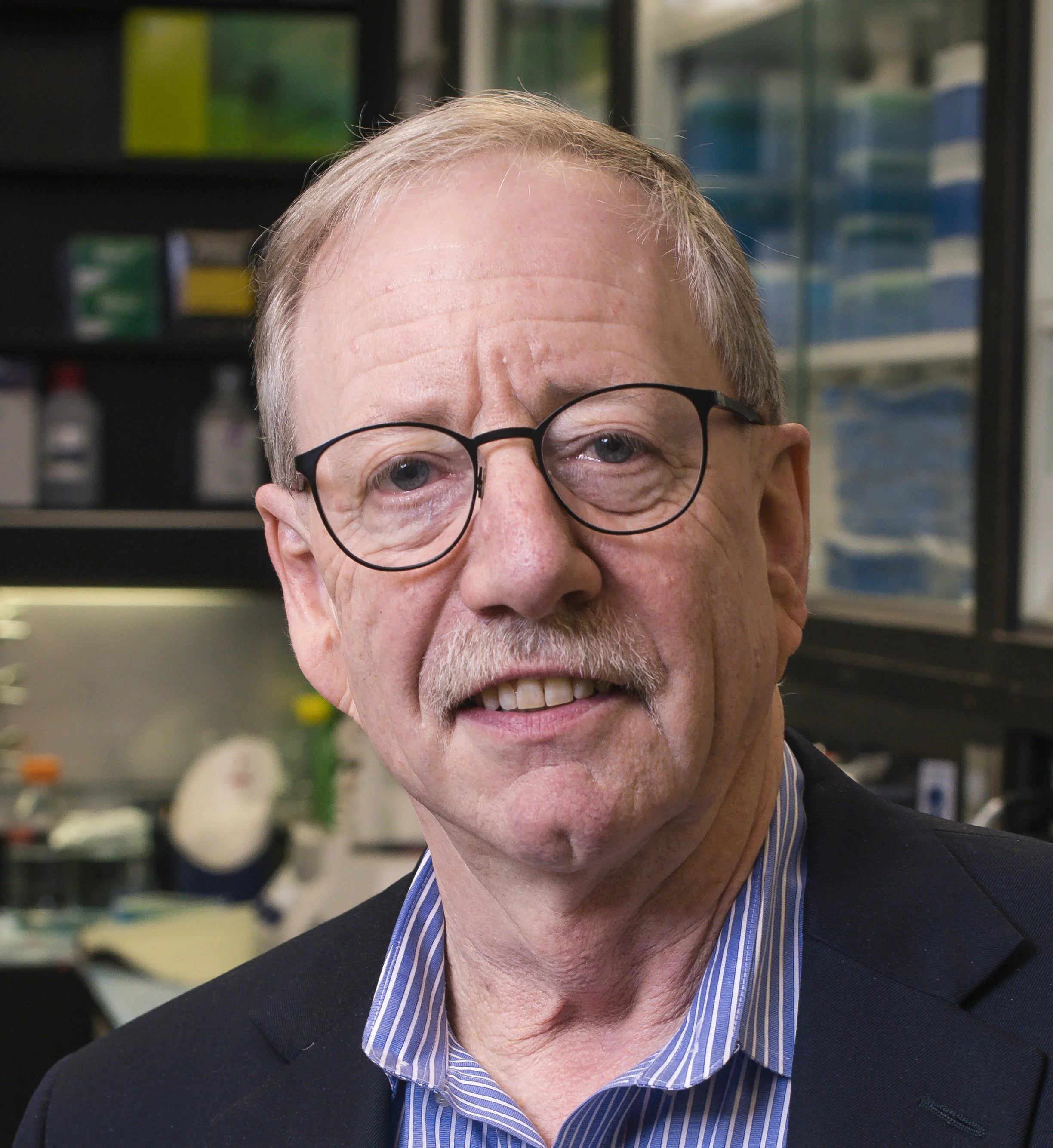
In this episode, we talk with Steve Austad, a distinguished professor and chair in the Department of Biology at the University of Alabama at Birmingham. After a winding career path that included lion training, Steve found his way to biology research and the study of aging. We talk with Steve about his early work in opossums, adaptations that allow species to be long-lived, and which treatments humans might use to extend our lifespan.
Cover art by Brianna Longo
-
Fran Bonier 0:06
Hey Cam, good to see you. How's it going?
Cameron Ghalambor 0:08
Not bad, Fran. It's good to see you again, co-hosting Big Biology. I'm looking forward to co-hosting more episodes with you into the future. How are you doing today?
Fran Bonier 0:17
Honestly, I'm not that great. I somehow hurt my neck sleeping on it wrong last night, and my knees are aching today. They sound like rusty hinges when I go up a flight of stairs. Getting old isn't easy.
Cameron Ghalambor 0:31
Oh man, I know what you mean. I'm recovering from a herniated disc in my lower back, and also a muscle strain that is taking forever to heal.
Fran Bonier 0:41
Why do we have to age at all, and why do some people seem to do it so much better than we are? Like I just read about Donna Jean Wild, a 61-year-old Canadian grandma who broke the women's world record for the longest plank at five hours. Five hours. I start shaking after a minute.
Cameron Ghalambor 1:02
She's not alone. Some people are doing things in their 80s and 90s that I couldn't have done at half their age. I just saw an article about a 90-year-old guy named Giuseppe Damato who set the world record for his age category just this past April at the Milan Marathon. He finished the marathon in four and a half hours. That finishing time dropped the record for a 90-plus age category by 100 minutes. Amazing!
Fran Bonier 1:31
Wow, that's incredible. So at first, why do we age might sound like a naive question. Senescence seems as inevitable as death and taxes, but if you look across the tree of life, the picture gets a lot more interesting. Some animals show little or no sign of aging at all.
Cameron Ghalambor 1:50
You're totally right. Some animals live for centuries with very little evidence of senescence. The ocean quahog clam has been reported to live over 500 years. The Greenland shark may be over 400 years, the bowhead whale at 200 plus, and I think as biologists, that's the part that's really interesting for us. All of these animals have the same basic cell biology, but really different outcomes in terms of their longevity.
Fran Bonier 2:18
Yeah, and some Hollywood icons like Tom Cruise or J. Lo or Paul Rudd, they seem to have dodged aging too. Maybe they've figured out that ocean clam secret. But seriously, if we could work out how these animals keep their cells and tissues in working order, it could tell us a lot about why we fall apart at the cellular and molecular level.
Cameron Ghalambor 2:40
And evolutionarily, aging is a real puzzle. Natural selection built us, our bodies with intricately coordinated anatomy, physiology, immune systems, self-repairing tissues. So why didn't it also give us the tools to maintain those bodies well past 50, 60, 70, 80, 90 years old? Was aging selected for, or is it what's left over when selection stops paying attention?
Fran Bonier 3:06
Right, and that's the heart of the classic theories: Medawar's idea that selection weakens with age, Williams' antagonistic pleiotropy, Kirkwood's disposable soma, they all say in different ways that our bodies aren't built to last forever because evolution mostly cares about what happens before and during reproduction.
Cameron Ghalambor 3:27
And those ideas are testable in the wild, which is where things get fun and interesting. For example, we would predict that animals facing a higher extrinsic mortality from predators or parasites should evolve to age faster, and we can go out in nature and find those animals to test that hypothesis.
Fran Bonier 3:45
Yeah, but of course, none of that has stopped people from trying to buy their way out of aging. Slowing or preventing aging is a multi-billion-dollar global market.
Cameron Ghalambor 3:56
Which is one reason why it matters that the science is real and very active with researchers attacking aging from mechanistic and evolutionary angles. Our guest today works at both levels.
Fran Bonier 4:08
Yes, Dr. Stephen Austad's joining us today. He is a distinguished professor and the inaugural Protective Life Endowed Chair in Healthy Aging Research in the Department of Biology at the University of Alabama at Birmingham.
Cameron Ghalambor 4:22
Steve is also the founding director and current co-director of UAB's Nathan Shock Center of Excellence in the Basic Biology of Aging. And for the past decade, he's been scientific director of the American Federation for Aging Research in New York.
Fran Bonier 4:38
He's also a terrific science communicator. His scicomm work includes two popular books that are relevant to today's conversation. He wrote the book Why We Age back in 1997. It's an excellent book. And also Methuselah's Zoo: What Nature Can Teach Us About Living Longer, Healthier Lives, that came out in 2020. Also, full disclosure, Steve was my master's supervisor a long time ago, so I'm especially excited to talk to him today.
Cameron Ghalambor 5:09
So let's hear from Steve.
Fran Bonier 5:11
Yeah, let's go.
Cameron Ghalambor 5:12
I'm Cam Ghalambor.
Fran Bonier 5:13
And I'm Fran Bonier.
Cameron Ghalambor 5:14
And this is Big Biology.
Fran Bonier 5:27
Dr. Steve Austad, welcome to Big Biology.
Steve Austad 5:30
Thanks, it's really nice to be here.
Fran Bonier 5:32
We're super glad you could join us, including coming in-person. It's a rare treat. So we're looking forward to talking a lot about the biology of aging and your career and your research, but before we started, I thought we'd go back to your background and you took a somewhat non-traditional path to your academic career.
Steve Austad 5:52
I would say non-traditional is an understatement. So, you know, I started off in college as a math major, but I was only a math major because I was good in math, and people expected me to be a math major. And one day in my freshman year, sitting in a math class, I realized I don't really like this. Why am I doing this? So I switched to English literature, and my undergraduate degree is actually in English. And what I wanted to do is I wanted to be the next Ernest Hemingway, you know, write the great American novel, and so after I graduated, I went searching for experiences to write the great American novel. I moved to New York. I drove a taxi in New York. I spent a lot of my college career becoming good at playing pool, so I hustled pool. And since you've never heard of my novel, you know, you kind of know how that worked out.
Fran Bonier 6:45
There are some books, though.
Steve Austad 6:46
Yeah, yeah eventually. And eventually, I was working as a newspaper reporter in Portland, Oregon, and a friend of mine got an offer to use his pet lions in a movie, and he asked me if I would help him transport them from Portland down to Hollywood. And when I got there, the producer offered me a job, and so I spent the next three and a half years training big cats for the movie business. I'd probably still be doing that. Well, I'm not sure because I found the movie people. I love being around the animals, but I found the movie people pretty boring. But I got fairly seriously injured one time, you know, I had time in the hospital to reevaluate my future, and I thought, you know, I'd like to study animal behavior in a more formal, academic sense. And as an English major, I had no credentials to qualify for graduate school, so I went back and was just taking classes while I was still working, and eventually, I got enough classes to go to graduate school, where I wanted to study lions in the wild. And since you've never read anything that I published on lions in the wild, you know how that worked out.
Steve Austad 7:54
So, but I ended up using my math background to do PhD on animal combat, game theory models of animal combat. So I still, this is nowhere close to aging, right? But now I'm in academics, at least. And I was doing a postdoc on avian social behavior in Venezuela when a friend of mine, at the same biological station, was catching so many opossums in his traps he couldn't do the project he wanted to do. And so I said to him, you know, in my informal way, you idiot, you're doing the wrong study. You should be able to study the animals you're catching. What are you catching? And he said, opossums. So I said, well, that's what you ought to be studying. So he said, well, what could we do that's of interest for opossums? So anyway, we wrote a grant and it got funded and had nothing to still had nothing to do with aging. It was on sex ratio manipulation.
Fran Bonier 8:49
And this was in Venezuela.
Steve Austad 8:50
This was in Venezuela. But in doing that project, I had to recapture these animals once a month. And in doing so, I realized they were aging phenomenally fast. Within a few months, they would go from being you know healthy, vigorous young adults to being ancient. They would lose muscle. They would have cataracts. They would all have all kinds of parasites. And I got really interested in that because I never suspected that an animal that's the size of a house cat would age as fast as a mouse, which is what they were doing, and I got so interested in that that I completely abandoned what I was doing before. The project I was originally working on was published in Nature, and by the time it came out in Nature, I'd totally lost interest in that topic, and I was off into aging. And it's managed to keep my interest and my attention, you know, for nearly four decades now.
Cameron Ghalambor 9:45
Yeah, that's awesome. So, I was in grad school, I think, when I first read about the possum work, and I was completely surprised and caught off guard by how short lived possums were. You know, I. I don't know. I didn't have like any strong expectations, but I didn't think they were practically like you know annual species. But you started working on them on Sapelo Island, and how did you end up going from Venezuela to Sapelo Island, and how did that research kind of get going out there?
Steve Austad 10:24
Yeah, so I had this idea that I could test this evolutionary theory of aging if I could find a population of opossums, and I thought opossums are great for this. Not only are they short lived, but you can mark them when they're in the pouch. So the pouch young, the size of an ant when they're born, so you can mark them at that point, so you know the exact age of everyone in a population very quickly. And so I had this idea of looking for an island that was deficient in predators, opossum predators that they might have evolved slower aging there, so I actually spent about two years surveying opossum habitat on various islands. The island of had to have, you know, no bridge to the mainland, so they had to be an isolated population. It had to have you know a vigorous population of opossums, and it had to lack predators. It turned out that Sapelo Island, which had a marine station from the University of Georgia, they just done a survey, a mammal and bird survey of the island. So I knew exactly what was there, and so they had opossums. They didn't have opossum predators, so it was perfect. And then I managed to get some funding and went down there and got started. The first year I was there, I took some undergraduates with me to help me. In fact, each year when I went back, I would take undergraduates. I was living in a travel trailer about half the size of the studio, but within a few years, you know, they'd all died, and oh, and I was comparing them to a mainland population, which is at the Savannah River Site, which is a nuclear weapons facility. And the only reason I was there is I wanted to do these field experiments, and I was looking for a place where nobody would mess with your field experiments. So the Savannah River Site is a nuclear weapons facility, and it's surrounded by barbed wire and a bunch of guys with machine guns, so I thought nobody is going to mess with my field experiments.
Fran Bonier 12:26
You'd never get permission to do that now.
Steve Austad 12:28
No, no, I'm sure you also wouldn't have. Yeah, yeah. So, so it worked out really well. So I went back and forth between these populations, and, you know, they were only about three hours apart, and yeah, it all and then the results turned out to be really interesting, which is the best part of it. You know, it could have turned out I would find nothing, but it turned out that the animals were in fact aging more slowly on the island.
Fran Bonier 12:53
So maybe for listeners that aren't familiar with the evolutionary theory, you could explain sort of the extra mortality?
Steve Austad 12:59
Yeah, so the idea is that evolution does not really care about how long animals live; it cares about how well they reproduce. And what this means is that even in an animal that doesn't age just because of accidental deaths, there will be fewer older ones and more younger ones, and that sets up an interesting dynamic where selection is very weak late in life, but quite strong early in life. And the implication of that is that late in life, mutations that can be very deleterious to health can accumulate because they don't impact reproduction, and also any mutations that would be beneficial early in life, even though they're detrimental later in life, you know, which is kind of a bizarre pattern if you think about it. But if there were mutations like that, they should be favored by evolution. And so, what sets the nature of this is basically the the type of extrinsic mortality, and the idea about islands is that they would have a reduced level of extrinsic mortality, and that's why I expected that if if all of the you know and these models of course have a number of assumptions built into them, but if all of the assumptions were met, that I'd actually find these two populations that differed in their aging rate., you know, and we knew the island had been separated from the mainland for about 5000 years. That's about 5000 opossum generations. So that seemed to me to be enough time for a significant divergence, even if selection was relatively weak. And there had been, you know, other studies that show that in the laboratory you could get divergence with strong selection a lot faster than that. So anyway, yeah, I spent three and a half years just chasing opossums around, you know, around the nuclear weapons facility and a weird island.
Fran Bonier 15:03
Do you think your background of sort of the nontraditional route is part of why you thought like most people wouldn't think opossums. Did that inform why you ended up in such a weird system?
Steve Austad 15:15
Yeah, I think because I didn't come through a biomedical background. I think always my whole career I have benefited by this weird trajectory I've taken because it allows me to think somewhat outside the box and, you know, and sometimes that works out to be really good. Sometimes it doesn't. Sometimes you end up doing dead end projects. But yeah, and then of course there was a serendipity of being introduced to opossums in Venezuela, which I'd never even thought about before. But they were marsupials; they were really interesting. I was originally interested in the playing possum behavior, which they rarely do, by the way, they're more they're more likely, especially in Venezuela, it seemed like to attack you than play opossum. Oh, really? Yeah, but I was used to wrangling lions, so wrangling opossums was not a big deal. Yeah.
Cameron Ghalambor 16:10
So I think we'll come back to talking more about some of the evolutionary processes that shape aging. But I think one thing that, for those of people who are who've read the aging work in opossums, there was some methodologies that you use that were really memorable, and they had to do with the collagen fiber breaking of the opossum tails. Can you talk a little bit about how you came up with that method?
Steve Austad 16:41
Yeah. So what I did, and when I changed fields, I basically said, if I'm going to be taken seriously in this field, I have to master the literature as well as the people who've been in the field. So in reading through the literature, I came through this technique for assessing the age of collagen. So collagen is a very simple molecule, but it ages. So our tendons and ligaments are almost pure collagen, and it turned out that some people working on mice had developed a technique for basically testing age. Now, what happens in collagen is that as it ages, very long-lived molecule. You know the collagen in your tendons and your ligaments you've had almost since you were born. Is that over time it develops cross links between the various molecules of collagen, and that changes the physical characteristics of it. So I designed a very simple instrument, prototyped in mice, that basically I could put a collagen fiber in a solution, hang a weight from it, and time how long it took it to break, and that really measured the number of cross links in it because I wanted to have a physiological marker of aging. I didn't want to rely entirely on demography, and so I became, you know, what I would do when I would catch an opossum is I would make a small slit in the tail, remove a few, you know, collagen fibers, and then suture it up again, and then the next time I caught them, I would do this again. So I actually had the rate of change of these collagen fibers as animals aged, and it didn't affect them. I mean, they have thousands of these fibers in their tail, and I would usually remove four.
Steve Austad 18:29
So, interesting follow up is that years after I did this study, BBC wanted to do a program that part of it was about opossums, and so they took me back out to Sapelo Island with the camera crew and all, and they wanted a picture of me doing this surgery. And this cameraman got really, really close. And you know, sometimes when you make a suture, you hit a little artery, and there's you know some blood. And the cameraman who was filming that suddenly just keeled over backwards because he was really focused on this area, and suddenly this blood welled up. But usually, the I mean, the opossums, you know, when I recaught them, one of the problems was even telling you know where I'd made the previous incision. It was it was really trivial to their health.
Cameron Ghalambor 19:15
So the mainland opossums, they I mean, I remember reading this and thinking like their tails are just like falling apart, and the equivalent aged opossums on the island, their tails were still robust and resistant to breaking. I guess.
Steve Austad 19:34
Yeah, yeah. I mean, we can tell this, and it's one of the reasons that athletes get more frequently injured. The older they get, as it changes in the properties of their tendons and ligaments, so this made and you could actually see this. And if you look at it carefully, collagen gets yellower as it gets older. So I could really tell the old ones from the young ones just by looking at the collagen eventually. But I did have this nice set.
Steve Austad 19:58
But the other thing I looked at is I looked at reproductive aging. And on the mainland, very few survived into a second year, maybe 10% of the population. And when they did, they were reproductively senescent. They're more likely to lose a litter. The litters grew more slowly. The litters, well, they were the same size, but they grew more slowly. On the island, on the other hand, a lot of them made it into the second year, and there was no difference in anything that I could measure through reproduction in the second year versus the first year. So that again gave me another reason to think these really are aging at a different rate.
Fran Bonier 20:36
Yeah and that's really been a hallmark of your work too, spanning from cellular molecular mechanisms and measures up to organismal function, and like you said earlier, by the time you started in the opposums, you were hooked.
Steve Austad 20:50
I was, and it was partly it was because it was such a cool question. You know, I mean, George Williams said that you know it's remarkable that nature can, you know, through morphogenesis and and the rest of development, create a healthy young adult out of a single fertilized egg, but it can't do seemingly the most simple thing, which is just maintaining that adult. And that and that just it's a cool thing. And I'd say the first 15 or 20 years I was studying aging I had no interest in any medical implications of it. It was just the evolutionary question that fascinated me,
Fran Bonier 21:28
and so the cellular approach to it was more to give it sort of that extra dimension of measuring aging rather than an interest at that time drilling to mechanism.
Steve Austad 21:38
Yeah, and I and I also think that it, you know, I, I distrust demography to a certain extent unless you can have a really huge sample, and I couldn't have a huge sample of my opossums. So I thought this just makes me feel like I can, you know, I can really back this result up in that I have survival data patterns. I have reproductive patterns, and I have this collagen aging.
Cameron Ghalambor 22:06
Yeah, well, and I think another aspect of your research that kind of stands out to me in the aging literature is that you've also worked on a lot of non-model organisms, and, you know, wild mice versus you know lab mice, for example. You know the possum work you've done work on bats. And I think one of the sort of take home messages I think for me has been that you know you can speak to sort of both the molecular cellular kind of mechanisms, but also the ecological context. And I know you like, for example, you've written about the longevity quotient, which I think gets back to your work with opossums and comparing differences in mortality. And one of the things that I remember that I had again I had never really thought about was that bats are relatively long-lived for their body size, so they have a longer longevity quotient, I guess. So, can you talk about what the longevity quotient is and how you sort of define it and apply it?
Steve Austad 23:15
Sure. This was something. So, you know, what shocked me, what got me into this was the opossum, size of a house cat, short, very short lived, and but I thought, well, how can I sort of quantify that? How short lived is it? And then there's this very robust relationship between body size and longevity, not just in mammals, but in just about every group of animals, that group of species that you could work at. So I thought, well, how can we do this? So, what we did is we just took the regression line between the log of body size, log of longevity, which is very linear over most of it of body size, and said, well, how much does individual species diverge from this? So, assume the regression line is a mammalian average, how short-lived is the opossum for its body size? It turns out there's some special tricks that you have to use. In doing this, I discovered that below about one kilo in body size, there's no relationship between size and longevity. I do account for that, but basically came up with this very simple ratio that we call the longevity quotient, which, you know, an average mammal would have a longevity quotient of one, and if an animal lived twice as long as you'd expect it to from its body size, it would have a longevity quotient of two. If it lived half as long, it would have a longevity quotient of 0.5. Turns out that bats, the longest-lived bat, which we also reported in the literature, has a longevity quotient of 10. By the way, humans it's about four and a half. Okay, so we live quite a bit longer than you'd expect if we were, you know, another animal is about the same size is a mountain lion, you know, and and and you know they live 20, you know, at the most.
Fran Bonier 25:05
Maybe 20 years, yeah.
Steve Austad 25:07
Yeah. And it turned out that that was a useful idea. It's been taken up by lots and lots of people, many of whom have their own, you know, sort of wrinkle on it. But I still think it's a very simple way to give, I guess, reality to how long lived really is this animal. And a mouse, by the way, a laboratory mouse lives about 70% as long as an average mammal of its size. A laboratory rat lives about half as long. That's why they're used, right? Because they age so
Fran Bonier 25:42
Quick turnover.
Steve Austad 25:43
Yeah, but on the other hand, expecting things that are that poor at aging to teach us something about human aging, that's a big leap of faith.
Fran Bonier 25:52
So, are there any longevity quotient of four model organisms that might be better models for human aging?
Steve Austad 25:59
There's lots of them. In fact, this is one of the things that I found so bizarre when I first got into the field is that you know there's 5000 plus species of mammals, and basically in the medical community they've compressed it down to one, you know, the laboratory mouse. And almost everything we know about molecular biology, mammalian aging comes from laboratory mice, which are very different. We know they're very different than humans, but it's a tradition that you just can't kill. But there are a lot better species that we could use. Rats would be better, for one. Used to be, rats were fairly common in aging research, but once the mouse genome came became so easy to manipulate; they got left behind. So now it's really basically lab mice and humans.
Cameron Ghalambor 26:53
So maybe going from the lab mouse, maybe to that that might be a good transition to kind of getting into some of the details about the mechanisms of aging and some of the interventions that, you know, have come out of the research on mice, and so one topic that I think has been of interest to you is is dietary restriction. I'm curious where things stand, like usually for most organisms, if you restrict diet, you get an increase in longevity. But I also know that in some cases, you can also stop reproducing. And so, where do we stand on our thoughts, like as far as diet restriction and longevity goes.
Steve Austad 27:41
Yeah, this is really an entry for me into basically talking to the biomedical folks about aging because the opossum work was fine. It was mostly of interest to the evolutionary biologists, but the dietary restriction stuff actually during my PhD, which was these game theory models of animal combat, I had manipulated a diet of spiders, and because I was trying to figure out how much each spider, how many eggs each spider would produce, and one way I would try to manipulate that is by feeding them various amounts. I wasn't interested in how long the spiders lived, but once I got interested in aging, and I found out there's this big dietary restriction literature, I said, "you know, I think I have some data from my PhD that I could use to write a paper". So my first paper was really on dietary restriction in these spiders because it made them live longer, you're right.
Steve Austad 28:39
So the field has evolved quite a bit for a variety of reasons. First of all, it's been really difficult to pin down the mechanism of dietary restriction. Now there are invertebrate models. You know, there's the nematodes, C elegans, and the fruit flies, and it's pretty obvious, because we can look at the mechanism so much easier in those. It's pretty obvious that they're doing the dietary restriction thing differently than mammals are. But the other thing is that the people that were working on that say that they were interested in mechanism, but they had a tough time nailing down a mechanism because dietary restriction changes so many things.
Steve Austad 29:19
But the other thing that happened is that humans finally started trying to do dietary restriction and the first study was an accidental study in this thing called Biosphere Two, and you know this huge three-acre, you know, crazy enclosure in Arizona, where you know six people went into that for two years with the idea that they were going to be totally self-sustaining, they were going to have no nothing come in, nothing go out, and it turned out they couldn't. They weren't very good farmers, and they couldn't produce enough food. So one of the researchers that was in this was a guy that had been studying dietary restriction in mice for ages, so he thought aha, you know this is my chance. And so they all went on a starvation diet, basically 1700 calories a day, even though they were working enormously hard to try
Fran Bonier 30:15
To try and farm
Steve Austad 30:16
To try to make food, and they lost a bunch of weight, and the other thing that happened. So they got really slender, and I had a picture of them naked that he had when they went in, and then he had another picture of them all naked when they came out. And I ran into him at an aging meeting. I said, "Hey, Roy, can I use those? I'm writing a book. Can I use those?" And he said, "Well, actually, you can't because everything having to do with that is under litigation. It turned out that the stress of doing that dietary restriction had turned them into enemies of one another. Somebody had been stealing food. They had to lock it up. And so that was the first one that made you think people can't do this. You know, it could be the healthiest thing in the world, and we still don't know because we don't know really how to translate it. And this may be of interest. So how do you translate? So how do you do these studies? You have mice in a box, let's say, in the simplest case. And you will you'll figure out how much they eat, if they could eat all they want, and then you will use that as the set amount, and then you will gradually now restrict their diet down to their 60, 70% of what they would like to eat. Now, how do you translate to people? Are we talking about Westerners who are you know who may be obese and cutting them down. I mean, it's not news if you say, "Hey, you know, if you're obese and you become less obese, it's good for your health." Or are we talking about people who are already a healthy body weight and reducing them by 30 to 40%? Well, there have been enough human studies now to know that people just can't do it. They cannot do it long term. They might be able to do 10%, with the exception of, I mean, there's this subculture of people that were doing it, and they were just. If you saw them, you would think that this is the unhealthiest person I've ever seen.
Fran Bonier 32:14
Has anyone tried to track health consequences of these human?
Steve Austad 32:18
Yes, they have and so I've actually been invited to speak at two of their international conferences, which was weird, you know. At the first one they said, "And will you be sticking around for the conference banquet?" And I said, "Oh, I said I would not miss the conference banquet."
Fran Bonier 32:38
At the dietary restriction
Steve Austad 32:39
Yeah and so yeah, it was a bunch of leaves and seeds with zero calorie dressing. And so, after the banquet, I went out and had dinner. But yeah, so they have. I mean, there's a lot of stuff. Their cardiovascular system is absolutely clean. Nobody that does this is going to die of a heart attack. Probably they're a lower cancer risk, but they have very little muscle because if they exercise, it makes them hungry.
Fran Bonier 33:08
Right.
Steve Austad 33:09
They have poor quality bones. I actually saw on a different BBC show, they actually had some guy that was doing this who was being followed, and BBC paid this guy to go give a complete physical workup. This guy was really doing it. I mean, he was a worker for the Ministry of Defense in the UK. He's a computer jockey, so he did everything. And they said to him, "Well, we're gonna if we pay for this complete physical, can we have you doing something active? So it looks like." So he said, "Well, I really don't do anything active because makes me hungry." So, well, "Can you maybe just swim across a swimming pool and we can do it? We can film it." And he almost drowned. I mean, you know, he had no body fat, so he had no buoyancy, and he had no muscle. So, I mean, and then one of the things that came back from his physical exam is, you know they said okay your cardiovascular system looks fantastic his blood pressure of 100 over 60 and they said but you're you have the bone and this guy's in his 40s you have the bones of a 70-year-old woman and he goes oh that's not so good he said. And we could detect zero testosterone in the system, and one of the things we know from the animal studies is they don't reproduce when you restrict them like that, and you know loss of libido is. And actually at one of the aging meetings I was talking to one of the guys who was dietary restricting himself. He was excruciatingly emaciated, and I was having dinner with him, dinner such as it was, with him and his girlfriend. I said to the girlfriend, "I said, well, they say that dietary restriction leads to a loss of libido. Is that true?" And she just got furious at me, and I thought, "Oh, I guess that was kind of an."
Fran Bonier 34:59
A little personal
Steve Austad 35:00
Yeah, it was insensitive of me to ask that, but that is one of the drawbacks. So you know, when you go to people in the evolutionary biology field and you say, you know, if you cut back diet, it extends health in a lot of animals. The first thing they always do is say, yeah, what's it do to reproduction? Yeah, because that's the way that we think about it.
Fran Bonier 35:21
We know about traits.
Steve Austad 35:22
And of course you start looking into it. Yeah, it delays puberty if you start before puberty to maybe three times the age of normal puberty. Often leads to sort of sterility and subfertility. I'm everything that all the tradeoffs that evolutionary biologists would just nod and say, "Oh yeah, that makes sense."
Fran Bonier 35:45
And in the field, right? It's hung around.
Steve Austad 35:49
Well, it's evolved. So what happened is about 20 years ago, a scientist at Harvard said, "I wonder how well it would protect against various kinds of, I guess, trauma, against stresses. And so he developed a technique for stressing a kidney. You know, he tied off the blood vessels to a kidney for a certain amount of time, and then released it. And he looked at how the animals responded, this was with mice. And he had several groups. He had groups that were had been dietarily restricted for a month, and but also ones that have been restricted, fasted for three days, and then two days, and then one day. And what he found was that two days of water fasts provided at least the short-term benefits that months of dietary restriction did, and that kind of changed the paradigm because people thought, and I now I'm kicking myself because I've been doing these experiments and I noticed that when you restrict these animals, they eat all their food in you know 30 minutes, and now they're fasting for 23 and a half hours, and we were so focused on what they were eating, we didn't think about the timing of the eating. And so we now know that these fasting diets have a lot of physiological benefits, and people can do, you know, a 16-hour fast. Anybody can do that if you're at all motivated. So the dietary restriction field has kind of evolved into now there's a handful of fasting diets.
Fran Bonier 37:30
So this is the intermittent fasting. It's quite popular
Steve Austad 37:34
That's right, intermittent fasting, time-restricted eating. These are all, I say, the offspring of dietary restriction.
Cameron Ghalambor 37:43
But getting back to sort of the idea of trade-offs, I mean, mechanistically, then is the the reason why dietary restriction leads to extended longevity because resources that would otherwise go towards reproduction get allocated towards survival? Or is it that you lose more body mass or muscle mass in particular, and so there's lower oxidative damage? What exactly is happening under the hood when you reduce the amount of calories?
Steve Austad 38:18
Well, the reason that people studied it for so long without being able to really nail this down is that that simple kind of intervention causes so many things to change. Part of it is certainly the reallocation of reproductive resources, but it's also a reallocation of immunological resources. You know, one of the side effects is a compromised immune system. Now, the people that do it, I ask them about that. I said, "Do you guys get? Do you get a lot of flus and cold and everything?" And they told me they never, they never got sick, and I believe them because these people follow, you know, their health to a fanatical extent.
Fran Bonier 39:03
They're logging everything.
Steve Austad 39:04
Yeah, I mean, if you ask them, you know, what's your BMI? They'll give it to you to three decimal points. You know, and say, and do you mean in the evening or in the morning when I wake up? So either there's something different about humans and mice, which I do think there is something different. Or humans just have not been exposed. My thought is, if you had if you had done this during COVID-19, the people that would were still doing this, I would be highly concerned about how they would respond.
Steve Austad 39:39
Now, the other thing that came out of these fasting studies is that things can switch back again very quickly. You know, one of the things that happened to these animals that were restricted after their surgery, they started eating again right away. The animals that have been getting fed all along after surgery, well, most of us who've had surgery know you don't feel like eating for a while. And then there are these molecular pathways that we know are associated with growth, with muscle, with lots of anabolic processes mediated through this network of mTOR. And we know that dietary restriction, you know, basically inhibits mTOR, but dietary restriction also reduces oxidative damage, you know, as you mentioned, and it does it by upregulating the repair processes and also by downregulating the generation of oxygen radicals. So, like I say, it turned out that this simple thing turned out to be really complicated.
Fran Bonier 40:40
Well, and that leads to the mTOR pathway, which also regulates inflammation, immune function. An interesting coincidence with the dietary restriction.
Steve Austad 40:51
It is, and the way we know about this kind of interesting, mTOR stands for mechanistic target of rapamycin, and it was discovered, so the inhibitor of mTOR is called rapamycin, and it was discovered in a soil bacteria on Easter Island, which is Rapanui in the local language. And it was originally studied in yeast, and they thought it might be an antifungal, but that's why it's called target of rapamycin. So this basically is the thing that rapamycin inhibits. It turns out though that it's connected to everything. I mean, in the medical literature, you're often reading about this pathway, that pathway. That's a misnomer. We should always say the mTOR network, the insulin signaling network, because these are complicated things.
Fran Bonier 41:45
They are all interconnected.
Steve Austad 41:46
And they've got complicated negative feedback and positive feedback. So, but mTOR clearly seems to be one key thing that all of the interventions that extend life and health, whether it's in worms or flies or mice or people, seem to inhibit mTOR.
Steve Austad 42:08
Now, that's not so good for some things. It's not so good for infectious diseases because it does inhibit immune function. And whether this is going to turn out to be something that we're going to pursue in humans is they're just starting human trials in this. There has been some interesting work though showing that when the first longevity experiments were done with rapamycin, at the same time somebody was looking at the impact of rapamycin on the immune system, and it turned out, sort of ironically and counterintuitively, if you gave mice a dose of a few weeks of rapamycin and then give them a and then try to give them the flu, you could rejuvenate the immune system of old mice with this rapamycin treatment. So you give them rapamycin for a couple of weeks, and then and then stop it, and then give them the flu, you know, inject them with the flu virus, and the old ones respond like the young ones. And when I read that, I thought, well, this is a mouse thing because it doesn't make any sense for humans. But then there was a human follow up where they did the same thing. Now, in the mouse studies, they gave them enough to kill most of the animals and the humans they they didn't want to do that, so they they did a study in in Australia where they gave people over 65 rapamycin for a couple of weeks and gave them the flu vaccine and then measured their antibody response, and they got a big boost in the antibody response of the people that have been on rapamycin for a couple of weeks. Now that's a complicated issue.
Fran Bonier 43:51
So, do you think maybe that the mTOR network is affecting inflammation and then sort of other wings of the immune system differently? Because we think of it as you know, maybe you suppress inflammation when you give rapamycin when you inhibit mTOR but maybe you're promoting other wings.
Steve Austad 44:08
Yeah one of the reasons that rapamycin has been difficult to get into human trials is that it's got a bad reputation to the physicians. And the reason is that it's used clinically now as part of an immunosuppressive cocktail when people have kidney transplants, but what it really is. And so people think of it as an immunosuppressant. But you're right on to it, Fran. What it really is is anti-inflammatory.
Fran Bonier 44:31
Right. So it's immunomodulating.
Steve Austad 44:35
That's right. Rather than immune suppressing, and so it may be that with the right dosing schedule, this is something that could change human aging, and just last year, the first big study of rapamycin in people was funded. So that it's just starting. So in the next five years, we'll probably have a pretty good idea about whether it works. Of course, you know, humans are terrible experimental animals. You know, you know, you can't take them apart and look at them. So it may be it may be that we need to figure out the dose. We need to figure out do they do you get it every day? Do you get it once a week? Do you get it once a month? We don't really know that.
Cameron Ghalambor 45:14
Yeah, I think the I mean, so another way of thinking about the mTOR pathway or network is that it's highly pleiotropic and has, you know, lots of consequences. I actually thought the the connection between mTOR and dietary restriction might be happening through IGF1 because mTOR sort of regulates insulin growth factor and insulin maybe having some, you know, would likely be influenced by dietary restrictions. So, but I don't know if that's actually the case, is it?
Steve Austad 45:49
Yeah. Well, it's quite interesting. So one of the things that I'd say every all the sort of mammalian biologists assume is that many of the effects of dietary restriction are through insulin IGF signaling, and we know that it affects that in a big way. However, we know that that's not involved in worm and fly dietary restriction, which is one of the reasons that I say they seem to be doing things a little bit differently. But you're absolutely right, and this is why I think you need to think of this as a network, because yeah, reducing the diet affects mTOR, but it also affects insulin signaling. I mean, insulin signaling was the, you know, the first player in the game, so to speak. The first thing that was really identified as something that was important in aging, and it was discovered almost at the same time in worms and flies and mice. But now people focus less on that than on mTOR. And yeah, but one of the you know one of the downsides of rapamycin it inhibits muscle growth. So for people that want to maintain muscle as they get older, it's not such a good thing unless we can find an intermittent dosing schedule.
Fran Bonier 47:01
And there's so much convincing evidence that exercise and strength are important in slowing senescence in humans.
Steve Austad 47:08
Yeah, yeah. I mean, both endurance exercise and resistance exercise. You know, we know that there's tons of data in humans on that. So it's all weak because it's human data because you can't really do, you know, the kind of experiments you'd like to do in humans, but it's very compelling because there's so much of it.
Fran Bonier 47:25
The idea of trade-offs, which we already talked about, when you have all these interventions that might do good things late in life, might they be messing things up early in life? Like, should we be more cautious about using these interventions in reproductive age, adults or or even children.
Steve Austad 47:44
Yeah, this that's a very good question because, certainly, and this is something that the biomedical community seems to have a problem with. Certainly, if you affect something as deeply embedded in our biology as the biology of aging, I think you'd be naive not to expect that there are going to be other effects that you may not be looking at. And fortunately, in people, you know, we can sort of decide when we want to. If we find interventions that are health promoting and longevity promoting, we can decide that we're not going to start them until, let's say, we're done reproducing. And one of the things that we've discovered over the last 20 years, where people have been studying rapamycin, for instance, is that at least in mice, it seems to have just about as big an impact if you start it later in life than if you start it early in life. Dietary restriction: the earlier you start it, the bigger effect you get, and that's what everybody was kind of assuming that you would get with the drugs as well. Turns out that's not the case. The first study that was published was done on mice that were about 60 years old in human equivalents. And that was not done by design because if they had been doing dietary restriction and starting it at that age, they wouldn't have seen anything. But what happened is they had a tough time getting rapamycin into the food. That's how they wanted to administer it. It was in the food, and it kept breaking down in the food. So they had to figure out how to do this. So they set aside these mice, and while they're figuring it out, the mice are getting older and older and older. When they finally figured it out by microencapsulating it, the mice were, you know, 60 years old, 20 months old in mouse. And then they had to make a decision. Do we do it with the mice we already have, or we start off with a new group? And if they had asked me, I would have said, "Don't even try it with these mice. They're too old."
Fran Bonier 49:35
Go get new mice.
Steve Austad 49:36
Yeah. Fortunately, they didn't ask me, and they went ahead and they did the experiment, and they got this remarkable result, which was from the time that these mice started getting the drug, they lived 30 to 40% longer than the animals that weren't. Now the way that they say it is, they say it was 15 to 16, but they were considering the whole lifespan. But they didn't start it till late in life. And my thought is, it makes sense to think about well, what's it do from the standpoint from when you started. So that was a shock, and we've seen this now in sort of drug after drug. If they work at all, they seem to work pretty well, even starting late. So I do think that if people started these things young enough, you would have to worry about this stuff. And I used to always tell the medical people, yeah, but it turns out you know 20-year-olds don't want to do this anyway because they think they're never going to get old, you know, they're not interested in this. That is people that are getting to at the past the age where they're still reproducing that suddenly get interested in it, like all the you know the zillionaires that recently have gotten interested.
Fran Bonier 50:41
Though it's shocking how many young people, young women especially, are using Botox.
Steve Austad 50:46
That is true. That is true. And yeah, in fact, having used to work in the film industry, I can tell you that. But you can understand this because, in a certain extent, I always thought it was ridiculous the amount of work that actresses had done. On, but on the other hand, if your livelihood depends on your looks, and to a certain extent, everybody's livelihood does to a certain extent more for women than men. So it's understandable. I'm pretty easy on the people that do that.
Cameron Ghalambor 51:28
Well, I think that is a good transition to kind of go back to some of the evolutionary hypotheses. So you mentioned earlier about selection being weaker on older individuals that are post-reproductive. And so when you read the evolutionary literature on aging, you know, the two sort of main hypotheses that are kind of positioned are the antagonistic pleiotropy hypothesis, you know, from George Williams that I think you already have described. But then the other idea is just mutation accumulation, and and I know having thought about those kind of hypotheses, they they can be hard to tell apart from one another, and I'm I'm curious like where you stand on are there individual sort of genes that have pleiotropic effects that kind of fit the antagonistic pleiotropy model? Or do mutations accumulate as we age and selection just gets weaker as we get older and isn't able to remove them?
Steve Austad 52:38
Yeah, well, I think that the weight of the evidence is massively biased towards antagonistic pleiotropy. I wrote a paper a few years ago that said something like "is antagonistic pleiotropy ubiquitous," because every time you know, and the best ways to look at it are in the model systems because they're so easy to manipulate. A every time you manipulate something to lengthen life, you compromise something, you know, earlier in life. Mutation accumulation is kind of harder . It's a harder thing to examine, but I think it certainly exists. I think a good example is cellular senescence. You know, cellular senescence was this phenomenon that cells have a limited number of replications they can go through. Well, when you're young, that's a good tumor suppressor. You know, so that's great. When you're old, though, it turns out those senescent cells become they accumulate and they become damaging. So that's a pretty good indicator of antagonistic pyotropy. The one thing that I've tried to make the case that might be mutation accumulation. See, I think there probably is a lot more than we think about, but it's a very small effect of lots and lots of genes. But there's this APOE polymorphism, right? So if you have APOE3 is the common allele. APOE4 is an allele that is associated with earlier onset cardiovascular disease, earlier onset Alzheimer's disease, and APOE2 has some small benefits. So, you think, well, why does APOE4 persist? You know, it's like the Huntington's disease gene. It's because people, even if you're going to die of a heart attack, you're not going to die probably while you're still reproducing, and certainly you're not going to get Alzheimer's disease at that point. So this may be an example, but my thought is there's probably a lot of it going on, but it's a lot of very small effects, so it's difficult for us to pick up. Now that we have all these human genomes and we have these huge data banks of of you know medical histories of people with their genomes, we could discover a lot of these things. But I'd say at the time right now.
Steve Austad 55:00
Now I'd say antagonistic pleiotropy is clearly going on, and I think that has important implications. And the important implications are this: if aging was mostly mutation accumulation, then the way that I would age and the way that you guys would age would be different. It would have to do with well, what mutations happen to occur in our ancestors. But the fact that we're finding the same networks that affect aging in worms and flies and mice and probably in humans, that by itself suggests to me that antagonistic pleiotropy is probably underlying all of this,
Fran Bonier 55:43
Right. Yeah. Do you think some of the cases where we think it might be mutation accumulation are just because we haven't yet figured out the beneficial effect early in life, because there's you sort of have the absence of evidence doesn't mean?
Steve Austad 55:55
Yeah. Well, that's why it's a harder that's a harder, you know, nut to crack, the mutation accumulation. It's much easier to evaluate antagonistic pleiotropy. So some of this may just be that the kind of experiments that you need to do are different, or the kind of observations in people. But again, I'm really optimistic that we're going to learn a lot more about people, just because, you know, everybody's genome is going to be available soon, and everybody's medical history, family history, and, you know, I mean, look what's happened with GLP ones so quickly. I have to say, this is probably the most promising drug for anti-aging. I hate that term, but it's hard to avoid anti-aging effects now. And that's only because millions of people are taking it, and so we've suddenly got information on millions of people, and that kind of obviates having to do clinical, you know, studies. So it may turn out that all the massive data that are going to be available on humans with a dose of AI is going to teach us a lot. And we won't have to rely on mice.
Cameron Ghalambor 57:07
Yeah I guess you know the one example that I've always kind of been curious about is with muscle atrophy as you age, so sarcopenia. And that muscle because of potentially experiencing more oxidative damage by having more mitochondria, may have higher mutation accumulation rates compared to other kinds of tissues, possibly, but also that these that mutations in the muscle fibers cause the the fibers to to break, and that might be one way, one sort of place where mutation accumulation might be be operating. I don't know. Have you thought about that?
Steve Austad 57:54
Yeah, it might be. I mean, one of the notable features of all of the interventions that seem to slow aging is that they all inhibit muscle, somehow. You know, the first genetic mutation in a mouse that made it live longer was a in a mouse called the Ames dwarf, and it was a single gene that inhibited the production of growth hormone and prolactin and thyroid stimulating hormone. But the interesting thing about those mice that you hear about is that their muscles don't age as fast, which is true but on the other hand, their muscles are pretty weak for their whole lives. It's like the muscles never really develop. They just don't they they just don't get worse faster.
Steve Austad 58:38
But all the other things, whether we're talking about rapamycin, whether talking about metformin, they all inhibit muscle growth. So now this is one place. So oxidative damage has kind of come and gone in the aging field. But one of the places that it's still probably important, I think, even the muscle stem cell people would probably tell you that it's yeah it's likely to be a player there, and I mean that's the other thing that we've learned about in the last, you know, 30 years is stem cells and what affects stem cells is ultimately what affects everything else. And so there's a lot of really interesting stem cell biology going on in aging now. But you know, oxidative stress went away, and the reason is that people found various ways of inhibiting it, either chemically or genetically, or other ways of emphasizing it, enhancing it, and those seem to have relatively little effect on the longevity of mice. And same thing happened to telomeres. Telomeres had a hot moment, you know. If you go to aging meetings, you never hear about them. If you go to cancer meetings, I'm sure you do. But go to aging meetings, nobody's talking about telomeres anymore. Scientific fashion, right?
Fran Bonier 59:55
Yeah. So we've got all these networks and pathways and mechanisms and signals and signatures of aging that are so highly conserved, but then also a repeated pattern that you see and that is a focus of your work now is sex differences. Why, if we're all so we're similar to C. elegans and yet males and females age differently, respond to interventions differently?
Steve Austad 1:00:17
Yeah, and I'd have to say there were two things. So now that we have we have a dozen drugs, at least, that are well established to keep mice healthy longer, make them live longer, and there are two things that have surprised me about these outcomes. One is the idea that they can have almost as big an effect if they started late in life as early in life, but the other thing is the sex bias and the effects. About three quarters of the drugs that we know of that make mice live longer only work in male mice. They don't work at all in female mice, and that was a shock to me. It remains shocking, and if that turns out to be the case in humans, and we don't know, but that means there could be a sort of. So now the new term is gerotherapeutics. So there may be a gerotherapeutic regime for men and a different one for women. And that's not too. If we'd found this in humans, I'd have been less surprised than if we found it in mice, because in humans there's this very clear pattern that women live longer than men. In mice there is no such pattern. So if you look at 100 mouse studies, and 30 of them the males will live longer, and 30 of them there'll be no difference, and 30 the rest the females will live longer.
Fran Bonier 1:01:37
Huh? Is that true in wild mice?
Steve Austad 1:01:40
I don't think we know, but interestingly, so all the drug work has been done in this one type of mouse. It's a genetically variable, but in a controlled way. They've taken four inbred strains and sort of interbred them with one another. In that particular group, in the way that they take care of them, the females do consistently live longer. So if you think about all these studies have gone on in a mouse in a genetic population of mice where females live longer. So if you figured, okay, it's the shorter-lived ones it's going to have the benefit, not the longer-lived ones. Maybe that makes more sense. But, I mean, we know in people, we know that people, you know, men and women respond differently to drugs. Drugs that are pulled off the market are most often 80% of them are pulled off because of side effects in women, not in men. And so, it would not surprise me if it turns out that. And we also know things like painkillers that work in one sex but don't work in the other, but you don't hear that from the pharmaceutical companies. So yeah, some of the common painkillers are well known to work well in males and not so well in women.
Fran Bonier 1:02:53
Really? Which ones?
Steve Austad 1:02:54
Yeah you never hear that. Yeah, yeah. Ibuprofen is one.
Fran Bonier 1:02:58
Really?
Steve Austad 1:02:58
Yeah, so there. This is an emerging pattern of things that I think have been haven't been suppressed, but for the longest time, you know, all the research was done on males in the animal world. And as of 2014, the NIH said you can't do that anymore. You have to use both sexes, and once they started doing that, they found out wow, all kinds of stuff that are different. So I'm really thinking there's this big drive now to personalized medicine. I'm thinking the first cut is going to be men versus women.
Fran Bonier 1:03:34
Right.
Steve Austad 1:03:35
So it's one of the things that I'm really focusing my a lot of attention on now because I think it's really interesting.
Fran Bonier 1:03:43
Yeah, it's fascinating. They're back and forth too. It's not always the same females where it doesn't work.
Cameron Ghalambor 1:03:51
So, I mean, not knowing anything about the about any of these mechanisms, but I mean, it to me it points to some sort of hormonal potential role here, because you know one of the ways that we know men and women differ is in their hormonal profiles, and we know these hormones affect many of these these pathways. So whether it's testosterone or estrogen, so are hormonal therapies part of the conversation when it comes to thinking about interventions for longevity?
Steve Austad 1:04:28
Well, it's interesting. So, so I wrote a book of you know in the late 1990s, and then somewhere in that book I said something like, if estrogen came from a exotic tropical herb, from what we know about it, would be considered a miracle drug, you know, for anti-aging properties. And not long after that, the Women's Health Initiative published a study showing that a lot of the benefits that we thought women were getting from, you know, hormone replacement therapy were not there. And suddenly I got really embarrassed about what I'd said about this. But now it's kind of changing back because people pointed out, well, that study was in women that had been postmenopausal for a decade on average before they started this, and so now there's kind of a reevaluation. So we'll see where this goes, at this point. Certainly, there are a couple of very weak but very vivid studies in men, where castrated men live longer, and I mean a lot longer. And like I say, the studies themselves are weak; they're done in weird situations. You know.
Fran Bonier 1:05:38
Yeah, you can't do the experiment.
Steve Austad 1:05:40
No, you can't do the experiment. It was done as much as a lot of people would like to you can't really do it. But the studies that exist, the differences in longevity are enormous, you know. And these were observations, but they're like 13 years, 20 years, and we all know that you know testosterone makes men go crazy early in life, but it's not that. But we know it has, you know, it does have some damaging effects. On the other hand, hormones are so pleiotropic; it's really hard to imagine hormone therapy that's not going to be, let's say, dirty. You know, all sorts of off-target effects. But some of the drugs, you know, one of the drugs that has had a big effect in men, not women, is a drug called 17 alpha estradiol. So it's not the feminizing estradiol— that's 17 beta. But it is an estradiol and it has these major effects in mice, but only in males. It doesn't have any effect in females. But the other possibility is that this has to do with chromosomal configuration, right? Men have an X and a Y, and women have sort of a redundant X, and maybe there are genes involved, and so that if they're compromised on the one X chromosome that males have, there's bigger effects than on the females. There's a number of hypotheses like this. My guess is it's going to turn out to be complicated. You know, humans, this is one thing that humans are really unique in, which is women always live longer than men.
Fran Bonier 1:07:23
Right.
Steve Austad 1:07:23
I don't care good times, bad times, doesn't matter.
Fran Bonier 1:07:26
I'm banking on it.
Steve Austad 1:07:28
Yeah, and that's not in any other species you can think of. It depends. A lot of it's environmental. You know, under these circumstances, males live longer. Under these, females live longer. Humans, that doesn't seem to be the case. It's it's it's it's really striking. We'll see. It's a hot area of research. I'm glad. I feel like I'm a pioneer in that because I started writing about this in 2004, when I think few people were thinking about it. But it's just so striking in women. I think a lot of times we ignore the stuff that, like everybody knows, so everybody knows it, but it's not, you know, nobody's curious about it. So everybody knows that women live longer than men. So what? Well, it could be that there's a tremendous amount that we can learn from understanding that difference.
Cameron Ghalambor 1:08:20
Yeah. So, I mean, I guess that leads to sort of the the kind of big question as far as you know these pro-longevity treatments go. Given what we've talked about so far today, that you know these pathways or networks they're very complicated. There's pleiotropy, a lot of off-target effects. There's trade-offs. What's the prospect for having, you know, some single intervention that is going to cut through all of this complexity and have like a beneficial effect? Like, is there a silver bullet that people are like looking for? I'm sure drug companies would love to have, you know, some product that they could sell. But given the, the as you said earlier, the the the fact that aging is so built into our biology, what are the prospects for actually, you know, extending human life much more than it already is.
Steve Austad 1:09:24
Well, we'll find out because we've kind of hit a ceiling right now. You know, life expectancy has really come to almost a stop, the increase in it, after, you know, increasing for 150 years by six hours a day. I think that we will ultimately be able to keep people healthy another 10 to 20%, but I don't think it's a. I think there's going to be a silver, a gold, and a platinum bullet because I think we're going to end up with combination therapies. There's going to be the sort of major thing that is the therapeutic benefit, and other things included to manage the side effects. Okay, so I, you know, there's this. I don't know if you guys are aware of this XPRIZE Healthspan that's out there now. So this is one of these competitive prizes. So the prize is to develop a therapy that basically restores function of the equivalent of 20 years in older people in muscle, in brain, and in immune function, and you have to do this by giving people a therapy for no more than a year. But the grand prize, if you can do that, is $81 million. So that's a pretty
Fran Bonier 1:10:45
An incentive
Steve Austad 1:10:46
that's a pretty good motivator. So I'm on the scientific advisory board of this thing, and we will see because this has really spurred a lot of research and a lot of thought. And that prize it goes to 2030. 2030 is the end of it. If somebody wins it, and it seems to me it's possible. So when we were thinking about the details of this, we said, "Well, we want to make this. We don't want to make it impossible. Well, we want to make it really difficult." And so it's going to be really interesting to see if anybody actually can pull this off. I think we know enough. I, you know, radical life expansion, you know, so I have this wager. I don't know if you guys know about my wager, but I have this wager.
Fran Bonier 1:11:32
I was hoping you would tell us about it.
Steve Austad 1:11:32
Yeah, yeah, about when the 150-year-old would be around. So for that to for that for me to win that bet, life expectancy is going to have to be about 100 years old, and we're nowhere near that now, although there are places in which it's in the high 80s. But I think that's not going to be traditional medicine. It's going to be have something that basically targets the biology of aging, and it, you know, I think 10 to 20% is achievable. And I only say that because we know dozens and dozens and dozens of ways to do this in the laboratory, experimental animals. Most of the stuff that we learn in the laboratory is going to turn out not to be relevant for people. It's just the way it is. We know even for cancer drugs, for Alzheimer's drugs, you know, one out of 10 is is really good. But if you have 20, 30, 40 possibilities, the possibility that one of them turns out to work, you know, I'm hoping my certainly my descendants are hoping.
Fran Bonier 1:12:35
You're optimistic of your chances.
Steve Austad 1:12:36
Yeah, and 150 years is that's 21 percent longer than the longest life. So for me to win the bet, only one person has to live that long.
Fran Bonier 1:12:45
Right, I was gonna ask that. Just one.
Steve Austad 1:12:45
One person. But they have to be cognitively intact, okay, they can't be in a vegetative state. So one person. So I say it's probably going to be a Japanese woman. But that you know, increasing the oldest old by 20% seems to me achievable. We'll see. I mean, right now the oldest person that we know about died in 1997 at the age of 122 and a half. Nobody has even reached 120 since she died.
Fran Bonier 1:13:20
Wow.
Steve Austad 1:13:20
So the guy I have the wager with loves to rub that in. I go, yeah, just wait, just wait. We'll see.
Fran Bonier 1:13:28
And what year does they have to make it to 2150?
Steve Austad 1:13:32
2150. By the year 2150. If so, so there's, you know, the people that can win, you know, are a minimum or a maximum of 26 years old now. So there's plenty of time now that we've figured. So, and if you think about the fact that the engineers like to point this out. Well, you know, in less than 70 years, we went from the first airplane to men on the moon, and yeah, that's true. But biology is not engineering. Biology is a lot more complex than space flight. So we'll see. You know, I'm still optimistic. In fact, I'm optimistic, and we made this bet in 2001. In 2014 a journalist talked it into doubling it. So it used to be a mere 500 million dollar bet, and now it's a $1 billion bet.
Cameron Ghalambor 1:14:24
Well it keeps going up with inflation.
Steve Austad 1:14:27
Yeah, well, no, this was based on the historical rate of growth in the stock market, right? And you know, the fellow Jay Olshansky, the demographer I had the wager voice, has been managing the money, and he's actually doing better than the rate in the stock market, so I'm thinking, man, he ought to be managing all my money. I, you know, heck with this $300, you know.
Cameron Ghalambor 1:14:50
Yeah. You know, when we then zoom back out again and look more broadly at other animals, I mean, there are some very long-lived organisms, you know, some marine mammals, some fish, Greenland shark, some rock fish that are get really, really old, tortoises. What can we learn from these? I mean, you know, obviously these are non-model organisms, but do they offer any clues as to how people might not only live longer but also like have a longer healthspan and and live higher quality of life as they get older?
Steve Austad 1:15:34
Yeah, I actually think this is where the big breakthroughs are going to come. I don't think it's going to come from the model organisms. And I and I say that because you know nature's had billions of years and, you know, billions of species to experiment with different things, and you know evolution is smarter than we are. Let's face it, and one of the things. So I suggested this a number of years ago that why are we spending all of our time studying aging and animals that are so poor at it, when we're so good already. You know, we've probably maxed out all the things that we're going to discover in them. When we know that there are animals out there that do things better, that repair their DNA better, their mitochondria stay healthy, their hearing stays good longer. Why don't we do that? Well, it's starting to happen, and one of the questions we didn't know, but, at the time, is there one way to be long-lived, or are there lots of different ways? You know, if there's only one way, that well, maybe that way is not so easily translated to humans. Turns out we now know the answer to that. There's lots of ways to be long-lived, and we don't all
Fran Bonier 1:16:41
We don't all have to hibernate or live in cold oceans.
Steve Austad 1:16:45
Yeah, we have to figure out which of those is going to be translatable, and I think some of them will be, some of them won't be. You know, elephants don't get cancer because they have 20 copies of the TP53 gene. That's we're not going to do that to our genome. Well, some people might. I mean, I was just at a conference where people were talking about what genes they're infusing into their body, which I think is completely crazy. But there are other things like this recently discovered, basically, molecule in the bowhead whales, that you know is fantastic at repairing the worst kind of DNA damage, the double strand breaks, and it's a cold-induced, you know, molecule. That's the kind of thing that we might be able to engineer, you know, something that does something similar like that. And nature's shown us. Look, this is what happened with GLP 1s, right? They were inspired by this molecule in the venom of Gila monsters, so somebody had the creativity to look at that and say, "I wonder if we could adapt that for human use?" And now we have GLP1s. I think the same thing is going to happen in some of the long-lived animals.
Fran Bonier 1:17:55
That is an optimistic place to end, and also a nice reminder of the importance of fundamental science and funding science.
Steve Austad 1:18:04
Absolutely, absolutely. Yeah, you never know where the breakthroughs. You know, who would have thought? You know, somebody studying venom in Gila monsters, and I'm sure there's some politicians somewhere. Yeah, said, why did we waste all this money? You know, on these. So yeah, that's really important. Everything starts with basic research.
Cameron Ghalambor 1:18:25
Yeah, yeah. Well, we like to usually wrap up by giving the guests an opportunity to say anything that you know that we didn't have a chance to cover that you'd like to share with people?
Steve Austad 1:18:38
Well, one thing is about the ethics of, you know, extending human life because you often hear people say, "Well, you know, the planet's already got too many people, and they're going to be resource shortages." You know, academics say, "Hey, and what about tenure? You know, there's going to be nobody's ever going to retire." And I think that that's not going to be the case. That's not a reason to not pursue this because we already have these problems. We can march through all the problems. They're here already. We're going to have to figure out how to deal with them. I would much rather have a group of politicians who had their senses still working on this than people that were.
Fran Bonier 1:19:20
That would be refreshing.
Steve Austad 1:19:20
Yeah, that would be refreshing than people that are already halfway on the road to dementia. So these are problems. You know, in 1907, the Nobel Prize-winning, basically, biologist Elie Metchnikoff said: "What are we going to do with all the old people? They're ruining the economy. They're taking up all the jobs, or we the cost of, you know, and life expectancy in France, where he lived at the time, was 50 years. Somehow, you know, we've bumbled through another century plus. My guess is most people would think things are better now than they were in 1907. So I'm, I think we shouldn't worry about this, but we need to deal with these problems, we can't ignore the problems of overpopulation, resource shortages, environmental degradation. We got to work on those.
Cameron Ghalambor 1:20:07
Well, great. Well, thanks, Steve. Thanks for taking time to talk to us today.
Fran Bonier 1:20:11
Yeah, thanks so much. That was fun.
Steve Austad 1:20:13
It's been a pleasure. I've really enjoyed it.
Cameron Ghalambor 1:20:27
Thanks for listening to this episode. If you like what you hear, let us know via Bluesky, Twitter, Facebook, Instagram, LinkedIn, or leave a review wherever you get your podcasts. And if you don't like something, we'd love to know that too. All feedback is good feedback.
Fran Bonier 1:20:42
Thanks to Steve Lane who manages the website and Molly Magid for producing the episode.
Cameron Ghalambor 1:20:48
Thanks also to Cass Biles for help with social media, Brianna Longo who produces our awesome cover images, and Clayton Glasgow who blogs about topics covered in the main show. Check out his work on our Substack page.
Fran Bonier 1:21:01
And thanks to our Substack and Patreon subscribers and the National Science Foundation for support.
Cameron Ghalambor 1:21:07
Music on the episode is from Podington Bear and Tieren Costello.